
Federal District Court Reinstates EEO-1 Pay Data Report

March 5, 2019

On Monday, February 4, 2019, the Federal District Court for the District of Columbia ordered that the EEOC’s EEO-1 pay data collection report be immediately reinstated.

The court ordered the Office of Management and Budget (OMB) to immediately lift its stay on the EEOC’s pay data collection report (known as Component 2), saying the decision to implement the stay was “arbitrary and capricious.”  The effect of this ruling is to permit the EEOC to begin collecting pay data at once.  It remains to be seen if this order is immediately carried out.

In a decision focused on the nuances of administrative law, Judge Tanya S. Chutkan sternly rejected OMB’s arguments that it was authorized to issue its stay on the grounds that changes in EEOC’s formatting requirement for the new pay report were burdensome on employers. Granting summary judgment for the plaintiffs, National Women’s Law Center and the Labor Council for Latin American Advancement, the court said that while there may be times when formatting changes could be considered burdensome, this situation was not it.

The ruling also rejected (1) OMB’s challenge to the plaintiffs’ standing to sue because they could not show the stay caused them any harm and (2) that the OMB’s decision to stay implementation was not reviewable because it was not a “final agency action.” The court found that the decision to stay the data collection was itself a harm and that it was reviewable.

The court concluded that because OMB’s action in staying EEOC’s collection of pay data “was arbitrary and capricious” and “totally lacked the reasoned explanation that the [Administrative Procedures Act] requires,” an immediate reinstatement was ordered.

Takeaways for employers: 

Although the court ordered the immediate implementation of EEOC’s Component 2 pay data collection, it is all but certain that OMB will appeal the decision and seek a stay of the court’s order pending resolution of the case.  In addition, once it has a quorum of Republican Commissioners, expect the EEOC to revise or eliminate the requirement to collect pay data. Janet Dhillon has been nominated as Chair and would be the second Republican on the EEOC; however, it is uncertain as to when the Senate will confirm her. Until she is confirmed, the EEOC does not have a quorum and cannot act.  This ruling may create an incentive for the Senate to act on her nomination promptly.

FortneyScott will keep you informed on how this issue will impact you.
October 13, 2026
Join FortneyScott attorneys on Wednesday, October 28, 2026 from 12:00pm to 1:00pm EDT for a timely and practical webinar on wage and hour. Wage-and-hour compliance continues to be a priority as it evolves in 2026, with new U.S. Department of Labor opinion letters addressing compensable time, travel, meal periods, rounding, bonuses, exemptions and tip practices, alongside significant federal enforcement activity. This one-hour webinar will examine the year’s most important federal developments and translate them into practical compliance lessons for employers. The program will also highlight distinctive District of Columbia wage-and-hour requirements, including current minimum and tipped wage rates, overtime, wage notices, pay statements and recordkeeping obligations, and will conclude with a practical wage-and-hour audit checklist. To register for this webinar, please CLICK HERE .
September 10, 2026
On August 21, 2026, the OFCCP finally published its final rules upending long-standing affirmative action requirements for federal contractors. While the elimination of EO 11246 regulations was expected, the substantial changes to Section 503 were less expected. By September 21, contractors must not only update their systems to remove now banned requirements but also determine how they will meet their affirmative action requirements without data collection. We will break down the most important developments, explain which obligations remain in place, and highlight practical steps organizations can take now to reduce risk, preserve defensible compliance practices, and prepare for what comes next. In this webinar, you will learn how to: Identify the OFCCP changes most likely to affect your affirmative action program strategy; Evaluate how revised Section 503 requirements may affect disability-related data collection, outreach, and documentation; Understand continuing VEVRAA obligations for protected veteran compliance. Manage transition issues for current and upcoming AAP cycles; and Prioritize practical next steps for policies, records, audits, and stakeholder communications.
August 27, 2026
Join FortneyScott attorneys on Thursday, September 10, 2026 from 12:00pm to 1:00pm EDT for a timely and practical webinar on the revised OFCCP regulations and how contractors should respond. To register, click here . On August 21, 2026, the OFCCP finally published its final rules upending long-standing affirmative action requirements for federal contractors. While the elimination of EO 11246 regulations was expected, the substantial changes to Section 503 were less expected. By September 21, contractors must not only update their systems to remove now banned requirements but also determine how they will meet their affirmative action requirements without data collection. We will break down the most important developments, explain which obligations remain in place, and highlight practical steps organizations can take now to reduce risk, preserve defensible compliance practices, and prepare for what comes next. In this webinar, you will learn how to: Identify the OFCCP changes most likely to affect your affirmative action program strategy; Evaluate how revised Section 503 requirements may affect disability-related data collection, outreach, and documentation; Understand continuing VEVRAA obligations for protected veteran compliance. Manage transition issues for current and upcoming AAP cycles; and Prioritize practical next steps for policies, records, audits, and stakeholder communication s. To register for this webinar, please CLICK HERE .
August 20, 2026
The U.S. Department of Labor (DOL) will publish in the Federal Register the three final rules impacting federal contractor regulations on Friday, August 21, 2026.  Executive Order 11246 regulations – DOL finalized the rescission of its regulations for EO 11246, effective October 26, 2026, to eliminate the obligations of federal contractors to prepare affirmative action plans based on race and sex, in addition to nondiscrimination provisions, and additional compliance requirements. This is to align with EO 14373, wherein President Trump rescinded EO 11246. Section 503 of Rehabilitation Act – DOL finalized the elimination of the disability self-identification requirements as well as the 7% utilization goal. In addition, the CC-305 Form will be eliminated. DOL holds that the Americans with Disabilities Act prohibits employers, including federal contractors, from collecting voluntary disability identification from applicants and employees. The nondiscrimination and reasonable accommodation requirements are maintained. Contractors with 50 or more employees and $50,000 or more in contracts will continue to be required to prepare affirmative action plans and to assess their outreach and recruitment. DOL moved the administrative procedures provisions from EO 11246 regulations here. VEVRAA – DOL’s revisions to the VEVRAA regulations were mostly technical, retaining the obligation to provide voluntary self-identification of veterans and to prepare affirmative action plans. DOL added the administrative procedures to these regulations and updated the jurisdictional threshold from $150,000 to $200,000. Please contact your FortneyScott attorney or email us at info@fortneyscott.com for more information.
July 21, 2026
The EEOC voted 2 to 1 on Tuesday, July 21st to issue a Notice of Proposed Rulemaking (NPRM) to rescind the requirement for employers and other covered entities to file an annual report with the EEOC summarizing aggregate data on their employees’ race and sex (reports known respectively as the EEO-1, EEO-2, EEO-3, EEO-4, EEO-5, and EEO-6 reports or EEO Data Reports). This includes the rescission of recordkeeping requirements related to these reports.  The proposal states that the Commission has determined the EEO Reports are inconsistent with equal employment opportunity law, may raise constitutional concerns, and that the collection of data is not narrowly tailored or necessary to enforce anti-discrimination statutes. EEOC determined that the reports, which had been collected since, 1966, have limited value, which was outweighed by the significant burdens they impose on employers and on the Commission. Once the NPRM is published in the Federal Register, individuals will have only 30 days to submit comments on the 60-page proposal. The Institute for Workforce Equality is planning to submit comments. Please contact your FortneyScott attorney or email us at info@fortneyscott.com with any thoughts you have on the proposed rescission, or on employer record-keeping obligations generally.
June 25, 2026
On Wednesday, June 24, 2026, the Office of Management and Budget’s (OMB) Office of Information and Regulatory Affairs (OIRA) extended EEOC’s information collection under the Uniform Guidelines on Employee Selection Procedures (UGESP) through June 29, 2029. UGESP requires employers covered by Title VII to collect and maintain records on the race, sex and ethnicity of those impacted by their employment selection procedures but does not require employers to report the data. EEOC and other enforcing agencies can then demand to see such data in connection with any investigation of employment discrimination. Please contact your FortneyScott attorney or email us at info@fortneyscott.com for additional information.
Show More
October 13, 2026
Join FortneyScott attorneys on Wednesday, October 28, 2026 from 12:00pm to 1:00pm EDT for a timely and practical webinar on wage and hour. Wage-and-hour compliance continues to be a priority as it evolves in 2026, with new U.S. Department of Labor opinion letters addressing compensable time, travel, meal periods, rounding, bonuses, exemptions and tip practices, alongside significant federal enforcement activity. This one-hour webinar will examine the year’s most important federal developments and translate them into practical compliance lessons for employers. The program will also highlight distinctive District of Columbia wage-and-hour requirements, including current minimum and tipped wage rates, overtime, wage notices, pay statements and recordkeeping obligations, and will conclude with a practical wage-and-hour audit checklist. To register for this webinar, please CLICK HERE .
September 10, 2026
On August 21, 2026, the OFCCP finally published its final rules upending long-standing affirmative action requirements for federal contractors. While the elimination of EO 11246 regulations was expected, the substantial changes to Section 503 were less expected. By September 21, contractors must not only update their systems to remove now banned requirements but also determine how they will meet their affirmative action requirements without data collection. We will break down the most important developments, explain which obligations remain in place, and highlight practical steps organizations can take now to reduce risk, preserve defensible compliance practices, and prepare for what comes next. In this webinar, you will learn how to: Identify the OFCCP changes most likely to affect your affirmative action program strategy; Evaluate how revised Section 503 requirements may affect disability-related data collection, outreach, and documentation; Understand continuing VEVRAA obligations for protected veteran compliance. Manage transition issues for current and upcoming AAP cycles; and Prioritize practical next steps for policies, records, audits, and stakeholder communications.
August 27, 2026
Join FortneyScott attorneys on Thursday, September 10, 2026 from 12:00pm to 1:00pm EDT for a timely and practical webinar on the revised OFCCP regulations and how contractors should respond. To register, click here . On August 21, 2026, the OFCCP finally published its final rules upending long-standing affirmative action requirements for federal contractors. While the elimination of EO 11246 regulations was expected, the substantial changes to Section 503 were less expected. By September 21, contractors must not only update their systems to remove now banned requirements but also determine how they will meet their affirmative action requirements without data collection. We will break down the most important developments, explain which obligations remain in place, and highlight practical steps organizations can take now to reduce risk, preserve defensible compliance practices, and prepare for what comes next. In this webinar, you will learn how to: Identify the OFCCP changes most likely to affect your affirmative action program strategy; Evaluate how revised Section 503 requirements may affect disability-related data collection, outreach, and documentation; Understand continuing VEVRAA obligations for protected veteran compliance. Manage transition issues for current and upcoming AAP cycles; and Prioritize practical next steps for policies, records, audits, and stakeholder communication s. To register for this webinar, please CLICK HERE .
August 20, 2026
The U.S. Department of Labor (DOL) will publish in the Federal Register the three final rules impacting federal contractor regulations on Friday, August 21, 2026.  Executive Order 11246 regulations – DOL finalized the rescission of its regulations for EO 11246, effective October 26, 2026, to eliminate the obligations of federal contractors to prepare affirmative action plans based on race and sex, in addition to nondiscrimination provisions, and additional compliance requirements. This is to align with EO 14373, wherein President Trump rescinded EO 11246. Section 503 of Rehabilitation Act – DOL finalized the elimination of the disability self-identification requirements as well as the 7% utilization goal. In addition, the CC-305 Form will be eliminated. DOL holds that the Americans with Disabilities Act prohibits employers, including federal contractors, from collecting voluntary disability identification from applicants and employees. The nondiscrimination and reasonable accommodation requirements are maintained. Contractors with 50 or more employees and $50,000 or more in contracts will continue to be required to prepare affirmative action plans and to assess their outreach and recruitment. DOL moved the administrative procedures provisions from EO 11246 regulations here. VEVRAA – DOL’s revisions to the VEVRAA regulations were mostly technical, retaining the obligation to provide voluntary self-identification of veterans and to prepare affirmative action plans. DOL added the administrative procedures to these regulations and updated the jurisdictional threshold from $150,000 to $200,000. Please contact your FortneyScott attorney or email us at info@fortneyscott.com for more information.
July 21, 2026
The EEOC voted 2 to 1 on Tuesday, July 21st to issue a Notice of Proposed Rulemaking (NPRM) to rescind the requirement for employers and other covered entities to file an annual report with the EEOC summarizing aggregate data on their employees’ race and sex (reports known respectively as the EEO-1, EEO-2, EEO-3, EEO-4, EEO-5, and EEO-6 reports or EEO Data Reports). This includes the rescission of recordkeeping requirements related to these reports.  The proposal states that the Commission has determined the EEO Reports are inconsistent with equal employment opportunity law, may raise constitutional concerns, and that the collection of data is not narrowly tailored or necessary to enforce anti-discrimination statutes. EEOC determined that the reports, which had been collected since, 1966, have limited value, which was outweighed by the significant burdens they impose on employers and on the Commission. Once the NPRM is published in the Federal Register, individuals will have only 30 days to submit comments on the 60-page proposal. The Institute for Workforce Equality is planning to submit comments. Please contact your FortneyScott attorney or email us at info@fortneyscott.com with any thoughts you have on the proposed rescission, or on employer record-keeping obligations generally.
June 25, 2026
On Wednesday, June 24, 2026, the Office of Management and Budget’s (OMB) Office of Information and Regulatory Affairs (OIRA) extended EEOC’s information collection under the Uniform Guidelines on Employee Selection Procedures (UGESP) through June 29, 2029. UGESP requires employers covered by Title VII to collect and maintain records on the race, sex and ethnicity of those impacted by their employment selection procedures but does not require employers to report the data. EEOC and other enforcing agencies can then demand to see such data in connection with any investigation of employment discrimination. Please contact your FortneyScott attorney or email us at info@fortneyscott.com for additional information.
June 11, 2026
The Directive is driving a significant shift in compensation reporting and transparency across the EU, and requires employers to disclose salary ranges to applicants, share internal pay-setting criteria, and conduct gender pay reporting. With the June 7, 2026, deadline for Member States to transpose the Directive into national law, employers need to understand their compliance obligations and prepare for unresolved implementation questions. In this webinar, FortneyScott attorneys will help U.S. companies with operations in the EU understand the Directive’s requirements, including how they differ from U.S. compliance frameworks. We will discuss best practice lessons that can be adopted from U.S. pay transparency and reporting laws and, importantly, provide key contrasts of the U.S. practices that are not applicable in the EU. Key topics include: The Directive’s scope and coverage Reporting obligations under the Directive Status of Member State transposition Practical compliance steps employers can take now Who should attend. This webinar is designed for in-house counsel, HR leaders, and senior professionals at multi-national organizations responsible for compensation, benefits, and employment law compliance.
May 21, 2026
Join FortneyScott attorneys on Thursday, June 11, 2026, from 12:00 p.m. to 1:00 p.m. EDT for a complimentary webinar on the European Union (“EU”) Pay Transparency Directive (the “Directive”). To register, please click here . The Directive is driving a significant shift in compensation reporting and transparency across the EU, and requires employers to disclose salary ranges to applicants, share internal pay-setting criteria, and conduct gender pay reporting. With the June 7, 2026, deadline for Member States to transpose the Directive into national law, employers need to understand their compliance obligations and prepare for unresolved implementation questions. In this webinar, FortneyScott attorneys will help U.S. companies with operations in the EU understand the Directive’s requirements, including how they differ from U.S. compliance frameworks. We will discuss best practice lessons that can be adopted from U.S. pay transparency and reporting laws and, importantly, provide key contrasts of the U.S. practices that are not applicable in the EU. Key topics include: · The Directive’s scope and coverage · Reporting obligations under the Directive · Status of Member State transposition · Practical compliance steps employers can take now Who should attend. This webinar is designed for in-house counsel, HR leaders, and senior professionals at multi-national organizations responsible for compensation, benefits, and employment law compliance. Register to attend. To register, please click here .
May 14, 2026
On Thursday, May 14, the U.S. Department of Labor’s Wage and Hour Division issued a technical amendment removing the salary threshold increases under 29 C.F.R. Part 541, adopted in April 2024. DOL stated that it was following the decisions made by federal courts in November, and that the amendment reinstated the 2019 salary levels applicable to the executive, administrative, and professional exemptions under the Fair Labor Standards Act. The current salary levels are $684 per week for exempt employees and $107,432 annually for highly compensated employees. This change codifies the enforcement posture DOL has maintained since the 2024 rule was invalidated. While this does not alter current compliance obligations, it resolves regulatory inconsistency by restoring the 2019 framework in the regulations and eliminating the 2024 provisions. Employers should confirm that exemption classifications continue to be evaluated against the reinstated 2019 thresholds and remain attentive to any future rulemaking in this area. Stay tuned. FortneyScott will continue to monitor whether there will be further substantive revisions to the white collar regulations. If so, it is likely be in the DOL’s regulatory agenda, which we understand will be published in the near future. Should you have any questions, please reach out to your FortneyScott attorney.
April 28, 2026
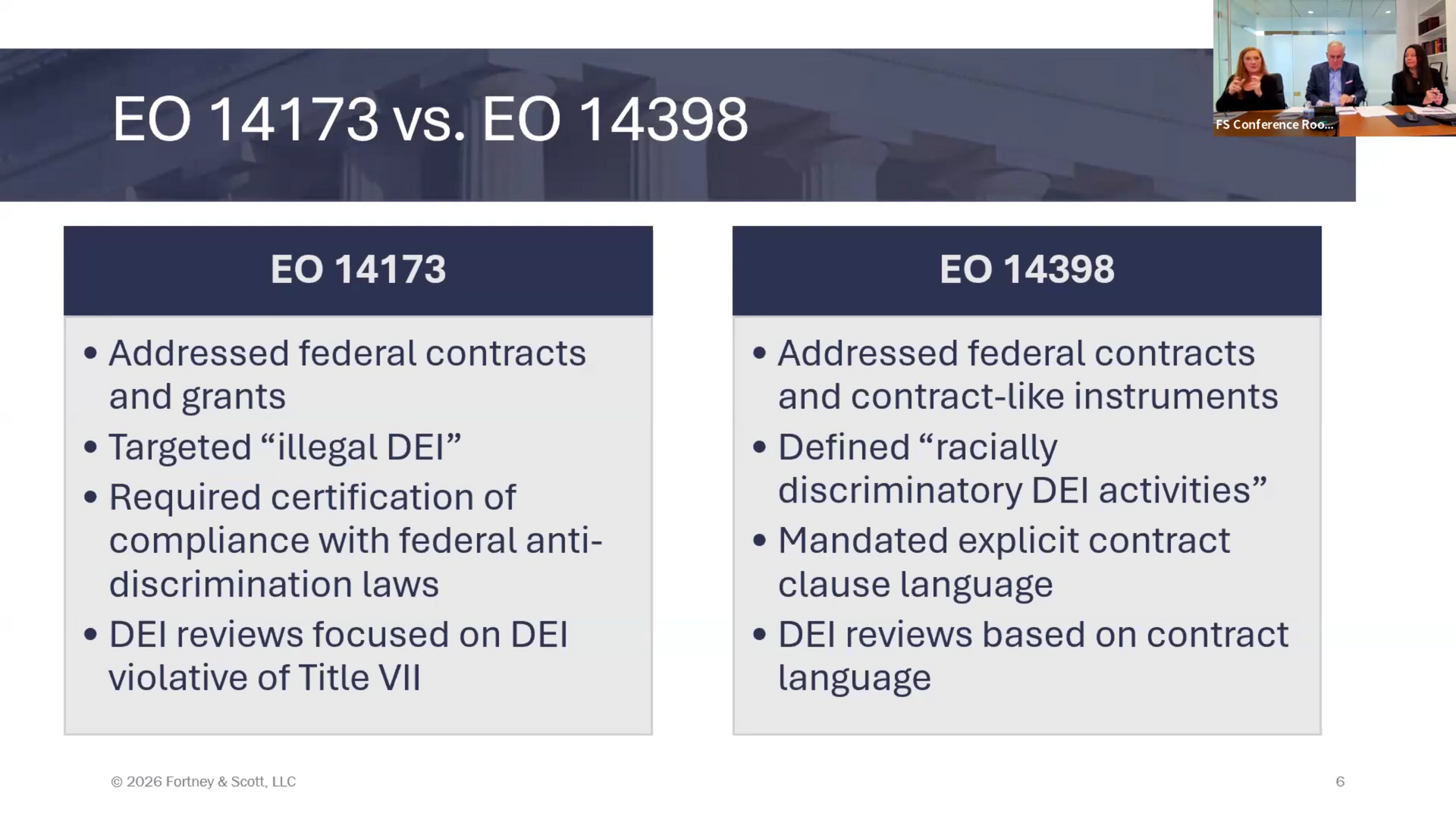
Federal contractors are facing immediate changes to implement stepped-up efforts to restrict DEI discrimination, including new mandatory contract clauses, expanded audits, and significant potential legal exposure. These far-reaching changes will impact prime contractors and all tiers of subcontractors. Any employer that is a federal contractor should immediately prepare for these new compliance obligations.
More Posts