FortneyScott 2nd Lunch & Learn: Mandatory Annual Compensation Disclosure: The Revised EEO-1 Report

February 12, 2016


FortneyScott is offering the second in its complimentary, five-part Lunch & Learn series
to assist you in responding to the new workplace regulations and compliance obligations. The second session is entitled,
Mandatory Annual Compensation Disclosure: The Revised EEO-1 Report.


Register here for the February 25th Lunch & Learn session.


At the White House on January 29, 2016, President Obama announced the Equal Employment Opportunity Commission (EEOC)’s proposed revision of the EEO-1, converting it into a vehicle to collect pay data. The proposed revision will add a component to the current EEO-1 report which requires disclosure of compensation and hours worked data by seven race and ethnicity categories and ten job categories, all to be displayed in the 12 pay bands proposed by the EEOC.


Early estimates have counted well over 1,000 different cells to be reported in each EEO-1 Report. This annual obligation is imposed on employers who have 100 or more employees beginning with the 2017 report.


The proposal to report W-2 pay data by pay band and EEO-1 job group raises many compliance questions for employers, from the scope of the compliance burden to the security of confidential compensation information. Join the Lunch & Learn to hear the issues discussed in depth.
April 29, 2026
SESSION 6: The Future of Global Pay Equity and Transparency – Caring for Employees
April 29, 2026
Fireside Chat with EEOC Chair Andrea Lucas
April 29, 2026
SESSION 4: Worker Categories, the 5% Gap,  and Joint Assessments
April 28, 2026
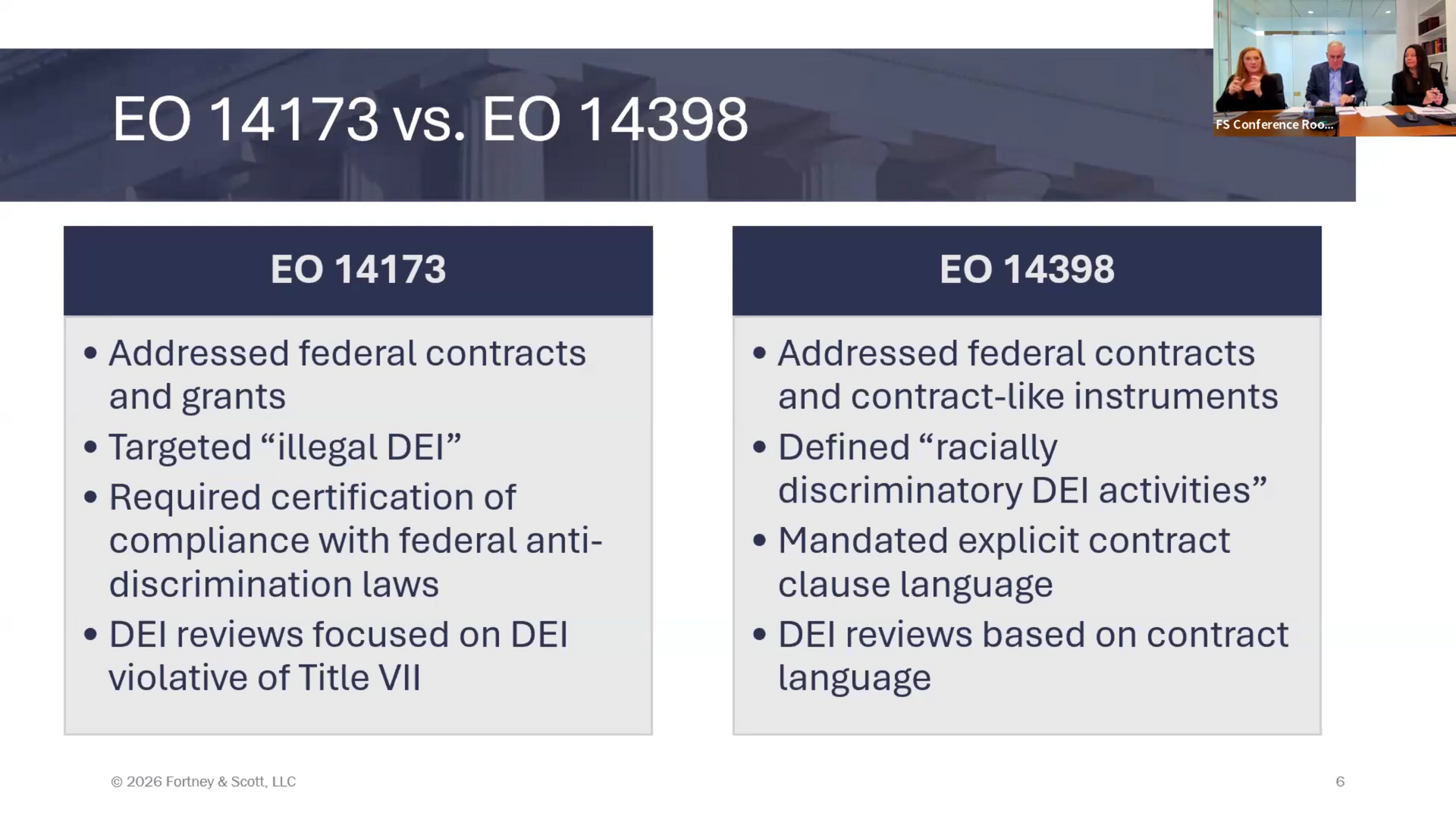
Federal contractors are facing immediate changes to implement stepped-up efforts to restrict DEI discrimination, including new mandatory contract clauses, expanded audits, and significant potential legal exposure. These far-reaching changes will impact prime contractors and all tiers of subcontractors. Any employer that is a federal contractor should immediately prepare for these new compliance obligations.
April 23, 2026
DOL Proposes New Joint Employer Standard In an effort to create a uniform, nationwide standard for determining joint employer status, the U.S. Department of Labor’s Wage and Hour Division will publish a Notice of Proposed Rulemaking (NPRM) in the Federal Register on April 23, 2026. The proposed Joint Employer Rule aims to restore a standard similar to the more business-friendly Trump 1.0 rule. Specifically, the proposed rule clarifies when multiple organizations would be considered joint employers under the Fair Labor Standards Act, the Family and Medical Leave Act, and the Migrant and Seasonal Agricultural Worker Protection Act. Comments are due within 60 days of the published date, or June 22, 2026. The proposed rule seeks to end nearly a decade of vacillating rules, as both the Trump and Biden administrations had tried promulgating a final rule previously. Those prior attempts created a series of conflicting executive and judicial rulings. As stated by acting Labor Secretary Keith Sonderling, this NPRM is intended to establish a “clear standard on joint employment.” Four-Factor Test The proposed rule modifies the Trump 1.0 standard, which focused heavily on requiring actual control by one company over another to establish joint employment. A prior judicial challenge to that approach was successful, requiring some modification to any new standard introduced thereafter. The proposed rule, therefore, responds by offering a four-factor test that is still heavily weighed on aspects of control. The four factors are whether a company: has the power to hire or fire a worker; supervises or controls a worker’s schedule or conditions of employment to a substantial degree; determines the rate and method of payment; and maintains a worker’s employment records. No single factor is dispositive, and the analysis will focus on the totality of the circumstances. Single National Standard Still a Goal The DOL acknowledged that some circuit courts continue to consider more factors and said the four listed factors were “not exhaustive.” Additionally, other federal agencies and several states have their own joint employer standards, some of which are directed at specific industries. For instance, the NLRB finalized its joint employer rule in late February 2026, with a similarly aligned standard that has some variances from DOL’s proposed standard. A final rule is anticipated soon after the comment period closes. Once issued, the rule may be subject to judicial challenges from interested parties that previously opposed similar regulatory approaches. Contact your FortneyScott attorney for additional information on how to submit comments and/or prepare for its impact on your workforce.
April 22, 2026
The Trump Administration Changes –  What Employment and Labor Lawyers Need to Know
Show More
April 29, 2026
SESSION 6: The Future of Global Pay Equity and Transparency – Caring for Employees
April 29, 2026
Fireside Chat with EEOC Chair Andrea Lucas
April 29, 2026
SESSION 4: Worker Categories, the 5% Gap,  and Joint Assessments
April 28, 2026
Federal contractors are facing immediate changes to implement stepped-up efforts to restrict DEI discrimination, including new mandatory contract clauses, expanded audits, and significant potential legal exposure. These far-reaching changes will impact prime contractors and all tiers of subcontractors. Any employer that is a federal contractor should immediately prepare for these new compliance obligations.
April 23, 2026
DOL Proposes New Joint Employer Standard In an effort to create a uniform, nationwide standard for determining joint employer status, the U.S. Department of Labor’s Wage and Hour Division will publish a Notice of Proposed Rulemaking (NPRM) in the Federal Register on April 23, 2026. The proposed Joint Employer Rule aims to restore a standard similar to the more business-friendly Trump 1.0 rule. Specifically, the proposed rule clarifies when multiple organizations would be considered joint employers under the Fair Labor Standards Act, the Family and Medical Leave Act, and the Migrant and Seasonal Agricultural Worker Protection Act. Comments are due within 60 days of the published date, or June 22, 2026. The proposed rule seeks to end nearly a decade of vacillating rules, as both the Trump and Biden administrations had tried promulgating a final rule previously. Those prior attempts created a series of conflicting executive and judicial rulings. As stated by acting Labor Secretary Keith Sonderling, this NPRM is intended to establish a “clear standard on joint employment.” Four-Factor Test The proposed rule modifies the Trump 1.0 standard, which focused heavily on requiring actual control by one company over another to establish joint employment. A prior judicial challenge to that approach was successful, requiring some modification to any new standard introduced thereafter. The proposed rule, therefore, responds by offering a four-factor test that is still heavily weighed on aspects of control. The four factors are whether a company: has the power to hire or fire a worker; supervises or controls a worker’s schedule or conditions of employment to a substantial degree; determines the rate and method of payment; and maintains a worker’s employment records. No single factor is dispositive, and the analysis will focus on the totality of the circumstances. Single National Standard Still a Goal The DOL acknowledged that some circuit courts continue to consider more factors and said the four listed factors were “not exhaustive.” Additionally, other federal agencies and several states have their own joint employer standards, some of which are directed at specific industries. For instance, the NLRB finalized its joint employer rule in late February 2026, with a similarly aligned standard that has some variances from DOL’s proposed standard. A final rule is anticipated soon after the comment period closes. Once issued, the rule may be subject to judicial challenges from interested parties that previously opposed similar regulatory approaches. Contact your FortneyScott attorney for additional information on how to submit comments and/or prepare for its impact on your workforce.
April 22, 2026
The Trump Administration Changes –  What Employment and Labor Lawyers Need to Know
April 21, 2026
Federal contractors are facing immediate changes to implement stepped-up efforts to restrict DEI discrimination, including new mandatory contract clauses, expanded audits, and significant potential legal exposure. These far-reaching changes will impact prime contractors and all tiers of subcontractors. Any employer that is a federal contractor should immediately prepare for these new compliance obligations. The Federal Acquisition Regulatory Council (FAR Council), which sets government-wide procurement policy and regulation for all federal agencies, has moved quickly to implement Executive Order (EO) 14398 , Addressing DEI Discrimination by Federal Contractors. Specifically, the FAR Council: Issued government-wide implementation guidance and class deviation language for all federal agencies to incorporate a mandatory contract clause, as prescribed in EO 14398, as soon as April 24, 2026, in new solicitations, and by July 24, 2026, for bilateral modifications of existing contracts. The class deviation authorizes agency-wide implementation of new requirements in federal contracts before the Federal Acquisition Regulations (FAR) are amended formally. Requested emergency approval, under the Paperwork Reduction Act (PRA), to allow immediate enforcement of EO 14398’s information collection and reporting requirements. Join FortneyScott for a complimentary briefing on Monday, April 27, at noon ET . Please register here . Contact your FortneyScott attorney for additional information on how to prepare for this new contract clause.
April 13, 2026
Employers need to continue to be vigilant in their compliance efforts for DEI and related programs. Here are two quick updates: To assist employers, our most recent DC Insider-Employer Update podcast – EO 14398 and the Procurement Power Play: Compliance, Contracts, and Consequences – provides a great overview of the newest Executive Order and federal contractor compliance. Additionally, late Friday, April 10 th , DOJ announced the first False Claims Act settlement based on DEI claims against IBM for $17 million. Please contact your FortneyScott attorney for more information, and visit our website ( www.fortneyscott.com ) for our recent special webinar .
April 13, 2026
The Trump Administration continues to push for the elimination of “illegal DEI.” Join FortneyScott attorneys on Thursday, April 9, 2026 at noon EDT to learn the latest developments by multiple federal agencies targeting DEI programs and policies. The webinar will address the key federal agencies’ expansive efforts, including: EEOC , focusing on the agency’s latest challenges to DEI, including expansive investigations of corporate DEI programs, subpoena enforcement litigation and limiting the rights of trans workers; DOJ , including the False Claims Act investigations, and challenges to the constitutionality of EO 14173 in 4th and 7th Circuits; FTC & FCC , highlighting the Mansfield Program, and warning law firms about antitrust compliance, and how DEI can impact regulatory approvals; and, Certification of Compliance , including GSA’s proposed Certification for grantees, and the implications for federal contractors. We also will provide key takeaways for DEI compliance, and steps to mitigate the risks of federal government enforcement actions based on illegal DEI matters. This webinar is the final in a three-part series designed for compliance professions, in-house counsel, HR and inclusion leaders, and other business leaders responsible for labor and employment law compliance.
March 31, 2026
In this special webinar we will address: Details of the new EO; The specific prohibition on “racially discriminatory DEI activities” in five key areas; The new requirements that add materiality to the contract payments and the expansion of the basis for False Claims Act exposure; New subcontractor management and reporting duties; Penalties and enforcement, including contract cancellation, debarment from future contracts and FCA actions by DOJ; and, The detailed implementation deadline for actions, including the new contract clauses, FAR Council guidance and agencies compliance report to the White House.
More Posts