OFCCP Issues 1,000 CSALs, and New Compliance Evaluations Will Commence in 2018

February 5, 2018

Federal contractors should be watching their mailboxes. On February 1, OFCCP mailed 1,000 Corporate Scheduling Announcement Letters and will begin mailing the formal Scheduling Letters on March 19, 2018.

OFCCP also announced significant modifications to its audit selection protocols including a limit of 10 establishments of a single contractor being placed on the scheduling list as well as no more than four establishments of a single contractor being placed in a single district office.  Most significantly, OFCCP expanded the prior two-year audit grace period by now providing that no establishment with a review closed in the last five years will be placed on the scheduling list.

Contact your FortneyScott attorney for more information about how these changes may affect your company or contact FortneyScott for more information.

The full DOL announcement can be read HERE.
March 27, 2026
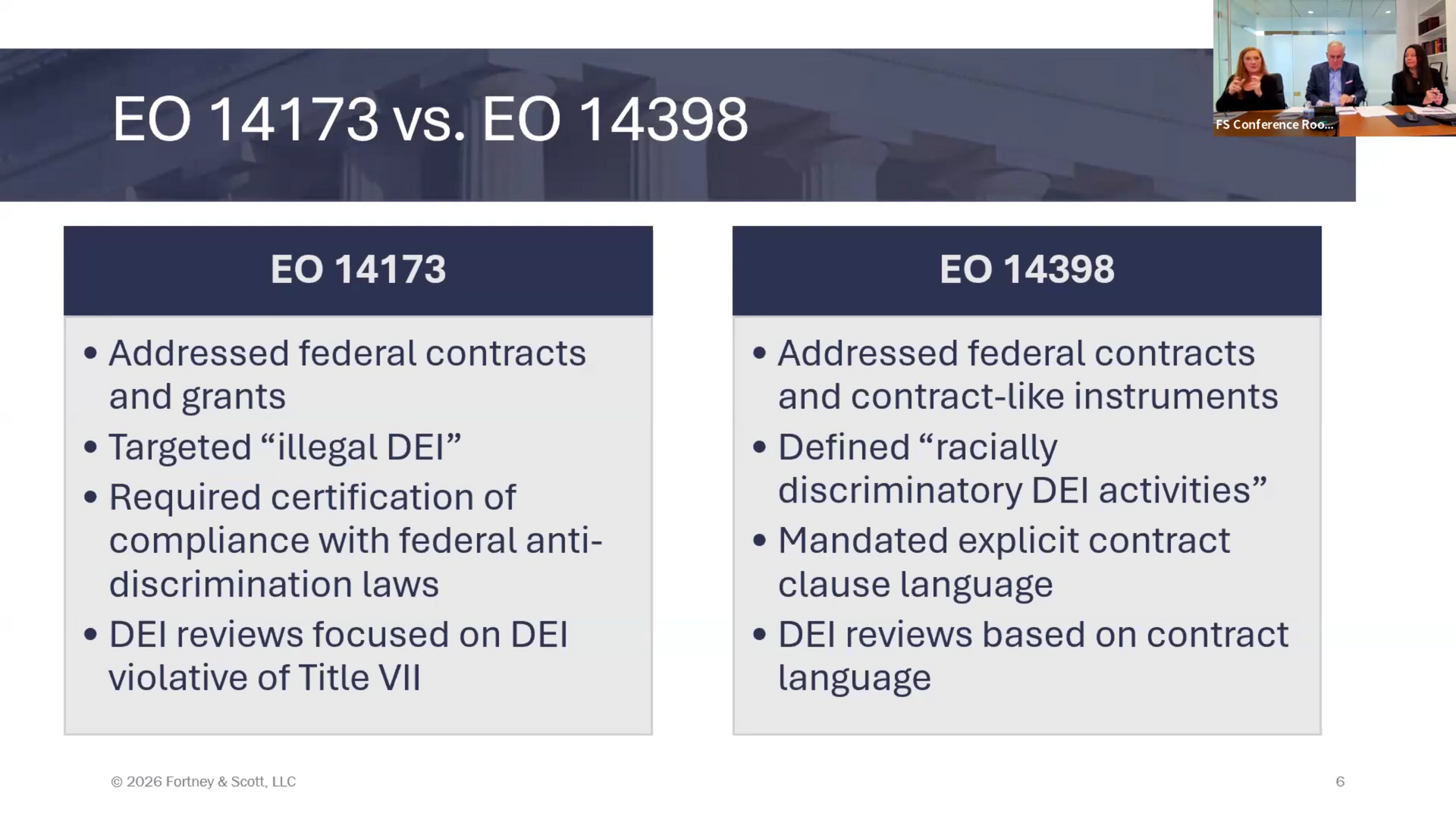
President Trump issued a new Executive Order on March 26, 2026, entitled “Addressing DEI Discrimination by Federal Contractors,” and accompanying Fact Sheet . The new EO fundamentally alters the compliance landscape for government contractors. While prior executive orders addressed DEI programs through policy directives, this new EO creates a mandatory, enforceable contract clause that exposes contractors to contract termination, debarment, and False Claims Act (FCA) liability. The Core Requirement: A New Mandatory Contract Clause Within 30 days (by April 25, 2026), agencies must insert a specific clause into all covered contracts, subcontracts, and lower-tier subcontracts. By accepting a contract containing this clause, contractors agree to six binding obligations: 1. The contractor will not engage in any “racially discriminatory DEI activities,” as defined in Section 2 of the Executive Order of March 26, 2026 (Addressing DEI Discrimination by Federal Contractors): 2. The contractor will furnish to contracting agencies all information and reports, including providing access to books, records, and accounts, for purposes of ascertaining compliance; 3. In the event of the contractor’s or a subcontractor’s noncompliance with this clause, the government contract may be canceled, terminated, or suspended in whole or in part, and the contractor or subcontractor may be declared ineligible for further Government contracts; 4. The contractor will report any subcontractor’s known or reasonably knowable conduct that may violate this clause to the contracting department or agency and take any appropriate remedial actions directed by the contracting department or agency; 5. The contractor will inform the contracting department or agency if a subcontractor sues the contractor and the suit puts at issue, in any way, the validity of this clause; and, 6. The contractor recognizes that compliance with the requirements of this clause are material to the Government’s payment decisions for purposes of section 3729(b)(4) of title 31, United States Code (False Claims Act). Immediate Action to Meet Deadlines Federal contractors face very short deadlines for the implementation of these new obligations, including the inclusion of the new contracting clauses within 30 days, by April 25, 2026. Federal contractors should initiate steps immediately to ensure compliance, including: 1. Audit Internal Programs: Review mentorship programs, ERGs, leadership development tracks, and supplier diversity initiatives for eligibility criteria based on race or ethnicity. 2. Update Subcontractor Agreements: Immediately begin flowing the mandatory clause down to all subcontractors and establish a monitoring system to satisfy the “known or reasonably knowable” reporting standard. 3. Review Invoicing and Certifications: Ensure that no compliance certifications or payment requests are submitted if prohibited activities exist. For More Information and Assistance Register now for FortneyScott’s special webinar, Federal Contractors’ New DEI Obligations that will be held on Tuesday, March 31, 2026 from 12:00 noon to 1:00 ET. This special webinar we will address: - Details of the new EO - The specific prohibition on “racially discriminatory DEI activities” in five key areas - The new requirements that add materiality to the contract payments and the expansion of the basis for False Claims Act exposure - New subcontractor management and reporting duties - Penalties and enforcement, including contract cancellation, debarment from future contracts and FCA actions by DOJ - The detailed implementation deadline for actions, including the new contract clauses, FAR Council guidance and agencies compliance report to the White House For more information on how federal contractors can comply with this new EO, contact your FortneyScott’s attorney or email us at info@fortneyscott.com .
March 20, 2026
The Trump Administration continues to push for the elimination of “illegal DEI.” Join FortneyScott attorneys on Thursday, April 9, 2026 at noon EDT to learn the latest developments by multiple federal agencies targeting DEI programs and policies. The webinar will address the key federal agencies’ expansive efforts, including: EEOC , focusing on the agency’s latest challenges to DEI, including expansive investigations of corporate DEI programs, subpoena enforcement litigation and limiting the rights of trans workers; DOJ , including the False Claims Act investigations, and challenges to the constitutionality of EO 14173 in 4th and 7th Circuits; FTC & FCC , highlighting the Mansfield Program, and warning law firms about antitrust compliance, and how DEI can impact regulatory approvals; and, Certification of Compliance , including GSA’s proposed Certification for grantees, and the implications for federal contractors. We also will provide key takeaways for DEI compliance, and steps to mitigate the risks of federal government enforcement actions based on illegal DEI matters. This webinar is the final in a three-part series designed for compliance professions, in-house counsel, HR and inclusion leaders, and other business leaders responsible for labor and employment law compliance. To register for FortneyScott’s Workplace Legal Compliance training series, please click here .
March 3, 2026
Having been fully funded for FY2026 and with new leadership in place, employers can expect much more from the Department of Labor in the second year of Trump 2.0. Join FortneyScott attorneys on Tuesday, March 3, 2026 at noon EDT to learn DOL’s priorities for 2026 and how to ensure compliance. Key Topics to be Covered Include: Overview of DOL Trump 2.0 officials Budget for FY2026 Next Steps from Wage & Hour Status of regulations PAID Program Return of Opinion Letters Child Labor enforcement FY2025 recovery Project Firewall Joint project with DOJ, EEOC and USCIS over H-1Bs Future of OFCCP – What to expect from the agency now that it has been funded Key Takeaways to ensure compliance This webinar is the second in a three-part series designed for compliance professions, in-house counsel, HR and inclusion leaders, and other business leaders responsible for labor and employment law compliance.
February 26, 2026
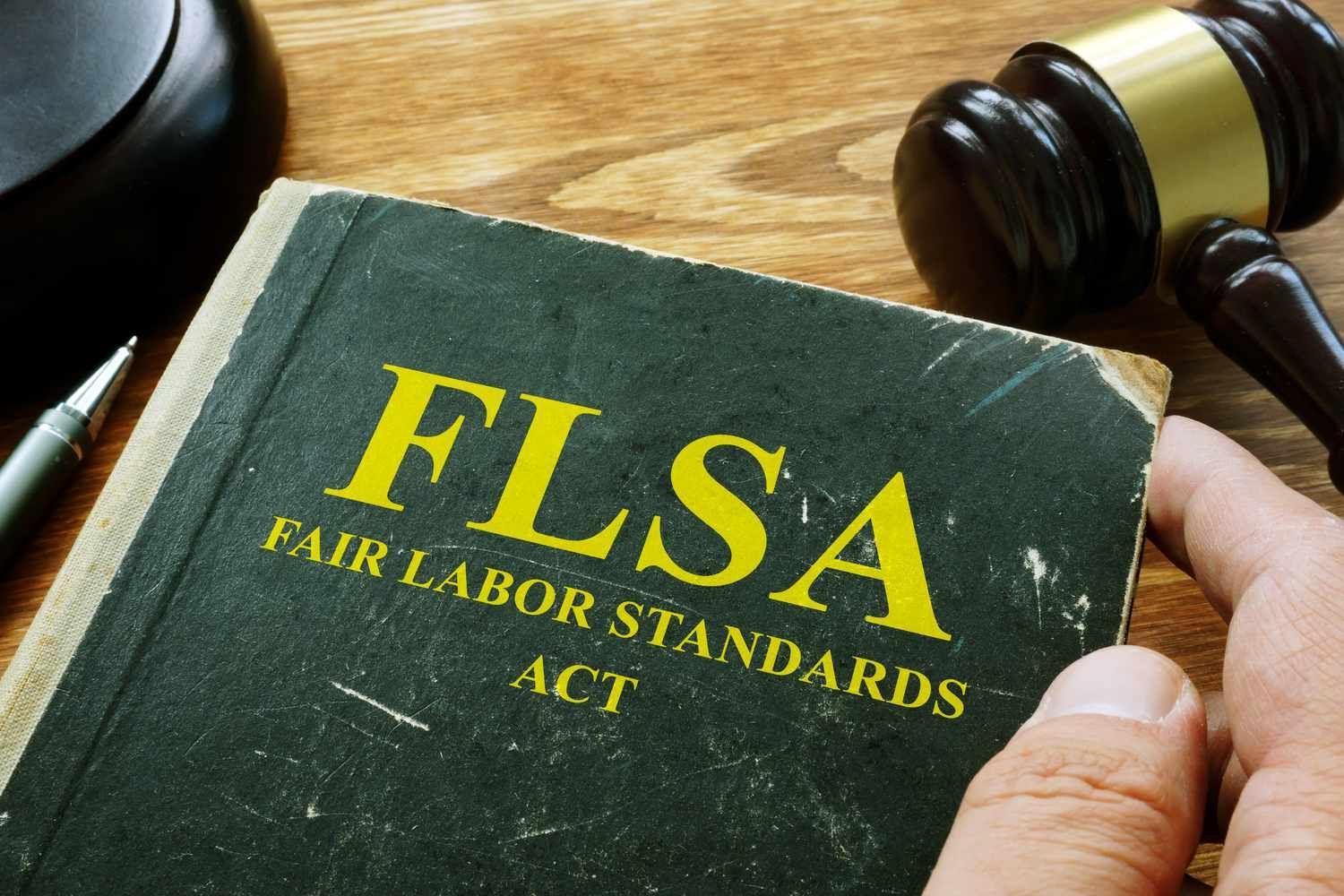
The regulatory landscape continues to shift – both the U.S. Department of Labor (DOL) and the National Labor Relations Board (NLRB) have announced regulatory changes relating to independent contractors and joint employment. Overview DOL has proposed largely returning to the independent contractor rule issued in the first Trump Administration that includes a streamlined five factor economic‑reality test. The NLRB has proposed reinstating the 2020 joint employer regulation. Both of these proposed regulatory changes are positive developments for employers and, if finalized, will provide greater clarity and certainty for employer compliance. More Detailed Information DOL Rulemaking : The DOL issued a significant proposed rule to determine employee versus independent contractor status under the Fair Labor Standards Act (FLSA). DOL’s proposed rule will reinstate, with modifications, the streamlined economic‑reality test adopted during the first Trump Administration in the January 7, 2021 final rule. Under the 2021 rule, the DOL applied a streamlined economic‑reality test that focused on whether a worker is economically dependent on the employer or is operating an independent business. The 2021 rule identifies five factors to apply with the first two factors carrying more weight : (1) the nature and degree of control over the work; (2) the worker’s opportunity for profit or loss; (3) skill required for the work; (4) permanence of the working relationship; and (5) whether the work is part of an integrated unit of production. The DOL’s modifications to the 2021 standard seek to clarify whether a worker depends on the company to provide work, as opposed to depending on their own business to generate work opportunities. The analysis focuses on the source of work, not the percentage of income the worker earns from a particular company. The DOL also proposes to extend this updated analysis to the Family and Medical Leave Act (FMLA) and the Migrant and Seasonal Agricultural Worker Protection Act (MSPA), both of which rely on the FLSA’s definition of “employment.” Key Takeaways for DOL IC Rule: The DOL’s 2024 rule, which established a six-factor test that created significant uncertainties when applied, will be rescinded. The DOL proposes returning to the 2021 rule’s five-factor test, with certain updates. The same analysis would apply under the FMLA and MSPA, aligning worker classification standards across these laws to reduce compliance and enforcement risks. The proposed changes support employer interests and will enable employers to assess independent contractor relationships and mitigate compliance and enforcement risks. If finalized, this rule should have wide-reaching implications for employers, contractors, gig economy platforms, and industries that rely on flexible labor models. NLRB Withdraws and Replaces its Joint Employer Regulation: The National Labor Relations Board will issue a final rule withdrawing its 2023 Joint Employer Rule in the Federal Register on Friday, February 27, 2026. This is following a March 8, 2024 decision by the U.S. District Court for the Eastern District of Texas. Chamber of Commerce v. NLRB , 723 F.Supp. 3d 498, 519 (E.D. Tex. 2024) vacated the 2023 Rule before it took effect. As a result, the Board is reinstating the prior 2020 Joint Employer Status Under the National Labor Relations Act, codified at 29 C.F.R. § 103.40, as the governing standard for determining joint‑employer status under the National Labor Relations Act. We will continue to monitor these rulemakings closely. Please reach out to FortneyScott, if you would like to submit comments to the agencies or conduct a proactive assessment of the existing independent contractor or joint employerrelationships.
February 25, 2026
A Perspective on Trends from the DOL and on a State Government Level
Show More
March 27, 2026
President Trump issued a new Executive Order on March 26, 2026, entitled “Addressing DEI Discrimination by Federal Contractors,” and accompanying Fact Sheet . The new EO fundamentally alters the compliance landscape for government contractors. While prior executive orders addressed DEI programs through policy directives, this new EO creates a mandatory, enforceable contract clause that exposes contractors to contract termination, debarment, and False Claims Act (FCA) liability. The Core Requirement: A New Mandatory Contract Clause Within 30 days (by April 25, 2026), agencies must insert a specific clause into all covered contracts, subcontracts, and lower-tier subcontracts. By accepting a contract containing this clause, contractors agree to six binding obligations: 1. The contractor will not engage in any “racially discriminatory DEI activities,” as defined in Section 2 of the Executive Order of March 26, 2026 (Addressing DEI Discrimination by Federal Contractors): 2. The contractor will furnish to contracting agencies all information and reports, including providing access to books, records, and accounts, for purposes of ascertaining compliance; 3. In the event of the contractor’s or a subcontractor’s noncompliance with this clause, the government contract may be canceled, terminated, or suspended in whole or in part, and the contractor or subcontractor may be declared ineligible for further Government contracts; 4. The contractor will report any subcontractor’s known or reasonably knowable conduct that may violate this clause to the contracting department or agency and take any appropriate remedial actions directed by the contracting department or agency; 5. The contractor will inform the contracting department or agency if a subcontractor sues the contractor and the suit puts at issue, in any way, the validity of this clause; and, 6. The contractor recognizes that compliance with the requirements of this clause are material to the Government’s payment decisions for purposes of section 3729(b)(4) of title 31, United States Code (False Claims Act). Immediate Action to Meet Deadlines Federal contractors face very short deadlines for the implementation of these new obligations, including the inclusion of the new contracting clauses within 30 days, by April 25, 2026. Federal contractors should initiate steps immediately to ensure compliance, including: 1. Audit Internal Programs: Review mentorship programs, ERGs, leadership development tracks, and supplier diversity initiatives for eligibility criteria based on race or ethnicity. 2. Update Subcontractor Agreements: Immediately begin flowing the mandatory clause down to all subcontractors and establish a monitoring system to satisfy the “known or reasonably knowable” reporting standard. 3. Review Invoicing and Certifications: Ensure that no compliance certifications or payment requests are submitted if prohibited activities exist. For More Information and Assistance Register now for FortneyScott’s special webinar, Federal Contractors’ New DEI Obligations that will be held on Tuesday, March 31, 2026 from 12:00 noon to 1:00 ET. This special webinar we will address: - Details of the new EO - The specific prohibition on “racially discriminatory DEI activities” in five key areas - The new requirements that add materiality to the contract payments and the expansion of the basis for False Claims Act exposure - New subcontractor management and reporting duties - Penalties and enforcement, including contract cancellation, debarment from future contracts and FCA actions by DOJ - The detailed implementation deadline for actions, including the new contract clauses, FAR Council guidance and agencies compliance report to the White House For more information on how federal contractors can comply with this new EO, contact your FortneyScott’s attorney or email us at info@fortneyscott.com .
March 20, 2026
The Trump Administration continues to push for the elimination of “illegal DEI.” Join FortneyScott attorneys on Thursday, April 9, 2026 at noon EDT to learn the latest developments by multiple federal agencies targeting DEI programs and policies. The webinar will address the key federal agencies’ expansive efforts, including: EEOC , focusing on the agency’s latest challenges to DEI, including expansive investigations of corporate DEI programs, subpoena enforcement litigation and limiting the rights of trans workers; DOJ , including the False Claims Act investigations, and challenges to the constitutionality of EO 14173 in 4th and 7th Circuits; FTC & FCC , highlighting the Mansfield Program, and warning law firms about antitrust compliance, and how DEI can impact regulatory approvals; and, Certification of Compliance , including GSA’s proposed Certification for grantees, and the implications for federal contractors. We also will provide key takeaways for DEI compliance, and steps to mitigate the risks of federal government enforcement actions based on illegal DEI matters. This webinar is the final in a three-part series designed for compliance professions, in-house counsel, HR and inclusion leaders, and other business leaders responsible for labor and employment law compliance. To register for FortneyScott’s Workplace Legal Compliance training series, please click here .
March 3, 2026
Having been fully funded for FY2026 and with new leadership in place, employers can expect much more from the Department of Labor in the second year of Trump 2.0. Join FortneyScott attorneys on Tuesday, March 3, 2026 at noon EDT to learn DOL’s priorities for 2026 and how to ensure compliance. Key Topics to be Covered Include: Overview of DOL Trump 2.0 officials Budget for FY2026 Next Steps from Wage & Hour Status of regulations PAID Program Return of Opinion Letters Child Labor enforcement FY2025 recovery Project Firewall Joint project with DOJ, EEOC and USCIS over H-1Bs Future of OFCCP – What to expect from the agency now that it has been funded Key Takeaways to ensure compliance This webinar is the second in a three-part series designed for compliance professions, in-house counsel, HR and inclusion leaders, and other business leaders responsible for labor and employment law compliance.
February 26, 2026
The regulatory landscape continues to shift – both the U.S. Department of Labor (DOL) and the National Labor Relations Board (NLRB) have announced regulatory changes relating to independent contractors and joint employment. Overview DOL has proposed largely returning to the independent contractor rule issued in the first Trump Administration that includes a streamlined five factor economic‑reality test. The NLRB has proposed reinstating the 2020 joint employer regulation. Both of these proposed regulatory changes are positive developments for employers and, if finalized, will provide greater clarity and certainty for employer compliance. More Detailed Information DOL Rulemaking : The DOL issued a significant proposed rule to determine employee versus independent contractor status under the Fair Labor Standards Act (FLSA). DOL’s proposed rule will reinstate, with modifications, the streamlined economic‑reality test adopted during the first Trump Administration in the January 7, 2021 final rule. Under the 2021 rule, the DOL applied a streamlined economic‑reality test that focused on whether a worker is economically dependent on the employer or is operating an independent business. The 2021 rule identifies five factors to apply with the first two factors carrying more weight : (1) the nature and degree of control over the work; (2) the worker’s opportunity for profit or loss; (3) skill required for the work; (4) permanence of the working relationship; and (5) whether the work is part of an integrated unit of production. The DOL’s modifications to the 2021 standard seek to clarify whether a worker depends on the company to provide work, as opposed to depending on their own business to generate work opportunities. The analysis focuses on the source of work, not the percentage of income the worker earns from a particular company. The DOL also proposes to extend this updated analysis to the Family and Medical Leave Act (FMLA) and the Migrant and Seasonal Agricultural Worker Protection Act (MSPA), both of which rely on the FLSA’s definition of “employment.” Key Takeaways for DOL IC Rule: The DOL’s 2024 rule, which established a six-factor test that created significant uncertainties when applied, will be rescinded. The DOL proposes returning to the 2021 rule’s five-factor test, with certain updates. The same analysis would apply under the FMLA and MSPA, aligning worker classification standards across these laws to reduce compliance and enforcement risks. The proposed changes support employer interests and will enable employers to assess independent contractor relationships and mitigate compliance and enforcement risks. If finalized, this rule should have wide-reaching implications for employers, contractors, gig economy platforms, and industries that rely on flexible labor models. NLRB Withdraws and Replaces its Joint Employer Regulation: The National Labor Relations Board will issue a final rule withdrawing its 2023 Joint Employer Rule in the Federal Register on Friday, February 27, 2026. This is following a March 8, 2024 decision by the U.S. District Court for the Eastern District of Texas. Chamber of Commerce v. NLRB , 723 F.Supp. 3d 498, 519 (E.D. Tex. 2024) vacated the 2023 Rule before it took effect. As a result, the Board is reinstating the prior 2020 Joint Employer Status Under the National Labor Relations Act, codified at 29 C.F.R. § 103.40, as the governing standard for determining joint‑employer status under the National Labor Relations Act. We will continue to monitor these rulemakings closely. Please reach out to FortneyScott, if you would like to submit comments to the agencies or conduct a proactive assessment of the existing independent contractor or joint employerrelationships.
February 25, 2026
A Perspective on Trends from the DOL and on a State Government Level
February 16, 2026
Having been fully funded for FY2026 and with new leadership in place, employers can expect much more from the Department of Labor in the second year of Trump 2.0. Join FortneyScott attorneys on Tuesday, March 3, 2026 at noon EDT to learn DOL’s priorities for 2026 and how to ensure compliance. Key Topics to be Covered Include: Overview of DOL Trump 2.0 officials Budget for FY2026 Next Steps from Wage & Hour Status of regulations PAID Program Return of Opinion Letters Child Labor enforcement FY2025 recovery Project Firewall Joint project with DOJ, EEOC and USCIS over H-1Bs Future of OFCCP – What to expect from the agency now that it has been funded Key Takeaways to ensure compliance This webinar is the second in a three-part series designed for compliance professions, in-house counsel, HR and inclusion leaders, and other business leaders responsible for labor and employment law compliance. To register for FortneyScott’s Workplace Legal Compliance training series, please click here .
February 12, 2026
Fortney Scott Attorney David Fortney Co-Chairs and Speaks at the Practicing Law Institute's Annual Wage & Hour Litigation and Compliance for 2026
February 5, 2026
DEI continues to be a high priority issue for the Trump Administration. Recent actions by multiple federal agencies, signal increased scrutiny of employer DEI programs. In the past week alone, the Administration has taken several significant actions: The EEOC filed a subpoena enforcement action against Nike based on a May 2024 Commissioner’s charge filed by EEOC Chair Andrea Lucas. The subpoena seeks company-wide information dating back to 2018, reflecting a more expansive approach to DEI-related investigation and increased willingness to pursue enforcement in federal court. The Chair of the Federal Trade Commission issued letters to 42 leading law firms warning that participation in the Mansfield Certification program may raise antitrust concerns. EEOC Chair Lucas was copied on the correspondence, highlighting coordinated federal agency attention to diversity-based initiatives. President Trump made additional demands on Harvard concerning its DEI-practices, substantially increasing the monetary demands from $200 million to $1 billion, while signaling the possibility of additional legal action, including potential criminal exposure. Federal funding was suspended for one of the largest infrastructure projects in the U.S., the $16 Billion Hudson Tunnel project, based on minority set aside contracting requirements, prompting litigation. This action, which impacts train services between New York City and New Jersey, underscores the intersection of DEI initiatives and federal funding risks. What should employers do now? In the current enforcement environment, employers should: Continue to assess DEI programs for legal risk. With a full EEOC quorum now in place, increased scrutiny of corporate DEI programs is likely. Although most employers have reviewed their DEI programs and made necessary changes to address legal compliance, the renewed focus on DEI requires ongoing assessment and update of DEI programs. Ensuring that these best practices remain in place and are followed is crucial. Prepare for the possibility of broader EEOC investigations. Recent enforcement activity reflects an increased willingness by the EEOC to pursue company-wide inquiries, often supported by expedited subpoena enforcement in matters that originate as individual discrimination charges filed by white employees and applicants. Evaluate participation in diversity rankings and certifications. Employers should evaluate whether participation in voluntary diversity assessments, ranking programs or other public reporting of diversity results unnecessarily raises the organization's profile and invites heightened scrutiny from the EEOC and other enforcement agencies. Please contact your FortneyScott attorney or email us at info@fortneyscott.com for additional information on how to be prepared and other best practices recommendations.
February 4, 2026
As we move further into 2026, employers should review notable changes to DC employment laws that may impact workplace policies and compliance obligations. Minimum and Living Wage Rates : From January 1, 2026, through June 30, 2026, any DC contract or government assistance recipient receiving $100,000 or more, as well as their subcontractors receiving at least $15,000 for contracts or $50,000 for government assistance, must pay at least the living wage rate of $17.95 per hour. Starting July 1, 2026, both the minimum wage rate and the living wage rate will increase to $18.40 per hour. For tipped employees, the base minimum wage increases to $10.30 per hour on July 1, 2026. Non-Compete Restrictions : Starting January 1, 2026, employers are banned from entering non-compete agreements with employees earning less than $162,164, and with medical specialists earning less than $270,274 Pay Stub Transparency : Starting January 1, 2026, employers must itemize all sources of compensation on employees’ pay stubs, including wages, bonuses, commissions, tips, service charges, etc.
More Posts