President Biden Announces New Measures to Combat COVID-19; OSHA to Issue ETS Requiring Vaccination or Weekly Negative Test

September 9, 2021

OVERVIEW:  Employers with 100 or more employees and federal contractors must ensure their workforces are fully vaccinated or require unvaccinated workers to produce weekly negative COVID-19 test results. These employers will also be required to provide paid time off for workers to get vaccinated or for workers to recover from any vaccine side effects. The vaccination requirements are part of the President’s six-prong, comprehensive national strategy outlined in a White House Fact Sheet.


NEW VACCINATION REQUIREMENTS:  President Biden announced on Thursday, September 9, 2021, that he is directing OSHA to issue an Emergency Temporary Standard (ETS) that will require employers with 100 or more employees to ensure that their employees are either fully vaccinated or that the unvaccinated employees produce a negative test weekly before coming to work. The ETS will also require these employers to provide paid time off for their employees to get vaccinated or to recover if they are “under the weather post-vaccination.” The ETS will be issued without any formal opportunity for comment, and no timetable has been announced.


In addition, the President signed an Executive Order directing federal government employees to be vaccinated within 75 days or be terminated. He is also extending the federal employee vaccination requirement to employees of federal contractors.


Finally, the President directed the Centers for Medicare & Medicaid Services to take action to require COVID-19 vaccinations for workers in most health care settings that receive Medicare or Medicaid reimbursements including but not limited to hospitals, dialysis facilities, ambulatory surgical settings, and home health agencies.


OPEN ISSUES:  There are numerous open issues including whether some of these initiatives exceed the President’s authority as well as timing and how obligations will be implemented for employers and federal contractors.


FortneyScott attorneys will continue to monitor developments and update you as soon as additional information is available. Feel free to reach out to any of the FortneyScott attorneys with questions. 
June 11, 2026
The Directive is driving a significant shift in compensation reporting and transparency across the EU, and requires employers to disclose salary ranges to applicants, share internal pay-setting criteria, and conduct gender pay reporting. With the June 7, 2026, deadline for Member States to transpose the Directive into national law, employers need to understand their compliance obligations and prepare for unresolved implementation questions. In this webinar, FortneyScott attorneys will help U.S. companies with operations in the EU understand the Directive’s requirements, including how they differ from U.S. compliance frameworks. We will discuss best practice lessons that can be adopted from U.S. pay transparency and reporting laws and, importantly, provide key contrasts of the U.S. practices that are not applicable in the EU. Key topics include: The Directive’s scope and coverage Reporting obligations under the Directive Status of Member State transposition Practical compliance steps employers can take now Who should attend. This webinar is designed for in-house counsel, HR leaders, and senior professionals at multi-national organizations responsible for compensation, benefits, and employment law compliance.
May 21, 2026
Join FortneyScott attorneys on Thursday, June 11, 2026, from 12:00 p.m. to 1:00 p.m. EDT for a complimentary webinar on the European Union (“EU”) Pay Transparency Directive (the “Directive”). To register, please click here . The Directive is driving a significant shift in compensation reporting and transparency across the EU, and requires employers to disclose salary ranges to applicants, share internal pay-setting criteria, and conduct gender pay reporting. With the June 7, 2026, deadline for Member States to transpose the Directive into national law, employers need to understand their compliance obligations and prepare for unresolved implementation questions. In this webinar, FortneyScott attorneys will help U.S. companies with operations in the EU understand the Directive’s requirements, including how they differ from U.S. compliance frameworks. We will discuss best practice lessons that can be adopted from U.S. pay transparency and reporting laws and, importantly, provide key contrasts of the U.S. practices that are not applicable in the EU. Key topics include: · The Directive’s scope and coverage · Reporting obligations under the Directive · Status of Member State transposition · Practical compliance steps employers can take now Who should attend. This webinar is designed for in-house counsel, HR leaders, and senior professionals at multi-national organizations responsible for compensation, benefits, and employment law compliance. Register to attend. To register, please click here .
May 14, 2026
On Thursday, May 14, the U.S. Department of Labor’s Wage and Hour Division issued a technical amendment removing the salary threshold increases under 29 C.F.R. Part 541, adopted in April 2024. DOL stated that it was following the decisions made by federal courts in November, and that the amendment reinstated the 2019 salary levels applicable to the executive, administrative, and professional exemptions under the Fair Labor Standards Act. The current salary levels are $684 per week for exempt employees and $107,432 annually for highly compensated employees. This change codifies the enforcement posture DOL has maintained since the 2024 rule was invalidated. While this does not alter current compliance obligations, it resolves regulatory inconsistency by restoring the 2019 framework in the regulations and eliminating the 2024 provisions. Employers should confirm that exemption classifications continue to be evaluated against the reinstated 2019 thresholds and remain attentive to any future rulemaking in this area. Stay tuned. FortneyScott will continue to monitor whether there will be further substantive revisions to the white collar regulations. If so, it is likely be in the DOL’s regulatory agenda, which we understand will be published in the near future. Should you have any questions, please reach out to your FortneyScott attorney.
April 28, 2026
Federal contractors are facing immediate changes to implement stepped-up efforts to restrict DEI discrimination, including new mandatory contract clauses, expanded audits, and significant potential legal exposure. These far-reaching changes will impact prime contractors and all tiers of subcontractors. Any employer that is a federal contractor should immediately prepare for these new compliance obligations.
April 23, 2026
DOL Proposes New Joint Employer Standard In an effort to create a uniform, nationwide standard for determining joint employer status, the U.S. Department of Labor’s Wage and Hour Division will publish a Notice of Proposed Rulemaking (NPRM) in the Federal Register on April 23, 2026. The proposed Joint Employer Rule aims to restore a standard similar to the more business-friendly Trump 1.0 rule. Specifically, the proposed rule clarifies when multiple organizations would be considered joint employers under the Fair Labor Standards Act, the Family and Medical Leave Act, and the Migrant and Seasonal Agricultural Worker Protection Act. Comments are due within 60 days of the published date, or June 22, 2026. The proposed rule seeks to end nearly a decade of vacillating rules, as both the Trump and Biden administrations had tried promulgating a final rule previously. Those prior attempts created a series of conflicting executive and judicial rulings. As stated by acting Labor Secretary Keith Sonderling, this NPRM is intended to establish a “clear standard on joint employment.” Four-Factor Test The proposed rule modifies the Trump 1.0 standard, which focused heavily on requiring actual control by one company over another to establish joint employment. A prior judicial challenge to that approach was successful, requiring some modification to any new standard introduced thereafter. The proposed rule, therefore, responds by offering a four-factor test that is still heavily weighed on aspects of control. The four factors are whether a company: has the power to hire or fire a worker; supervises or controls a worker’s schedule or conditions of employment to a substantial degree; determines the rate and method of payment; and maintains a worker’s employment records. No single factor is dispositive, and the analysis will focus on the totality of the circumstances. Single National Standard Still a Goal The DOL acknowledged that some circuit courts continue to consider more factors and said the four listed factors were “not exhaustive.” Additionally, other federal agencies and several states have their own joint employer standards, some of which are directed at specific industries. For instance, the NLRB finalized its joint employer rule in late February 2026, with a similarly aligned standard that has some variances from DOL’s proposed standard. A final rule is anticipated soon after the comment period closes. Once issued, the rule may be subject to judicial challenges from interested parties that previously opposed similar regulatory approaches. Contact your FortneyScott attorney for additional information on how to submit comments and/or prepare for its impact on your workforce.
April 21, 2026
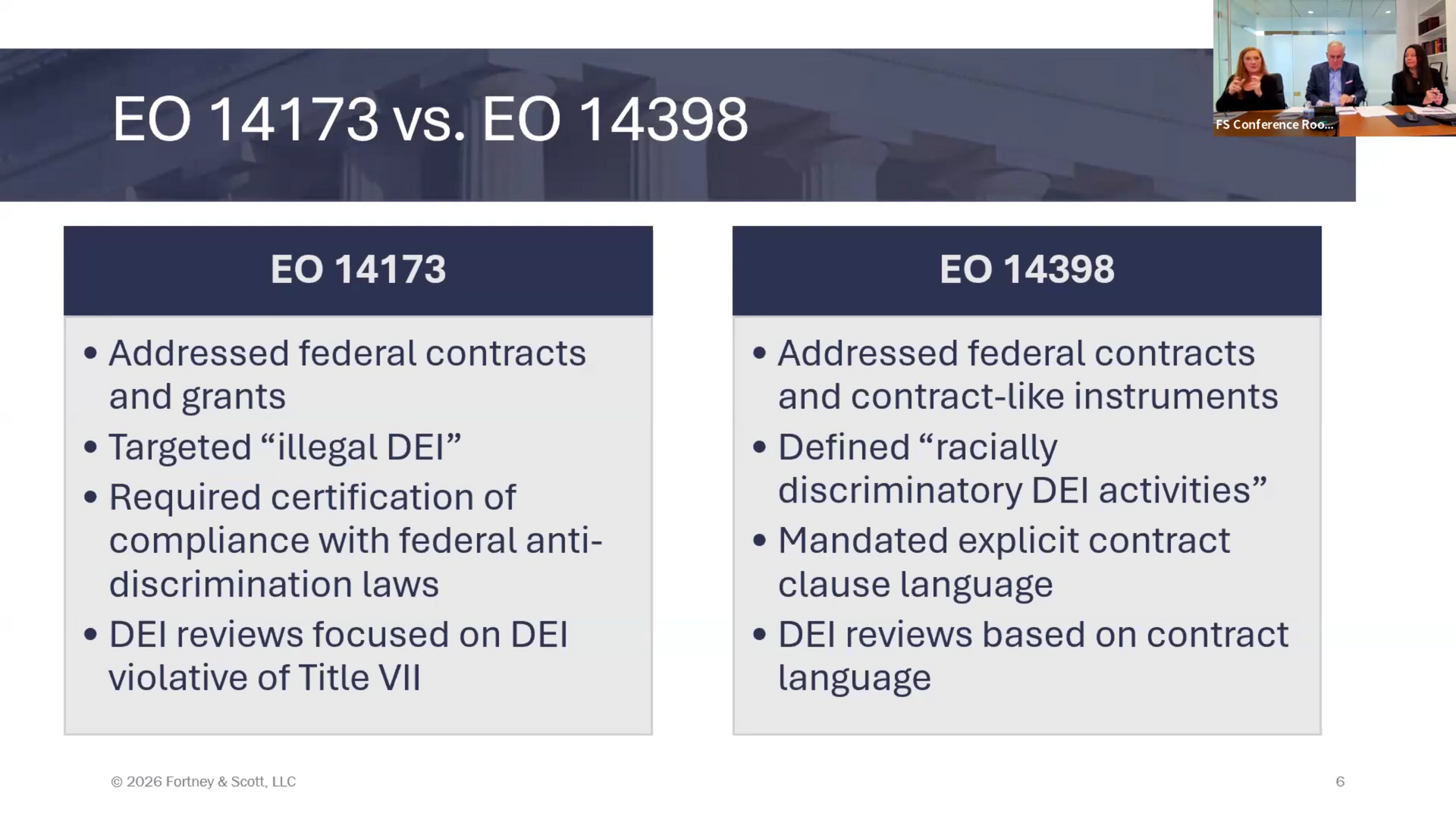
Federal contractors are facing immediate changes to implement stepped-up efforts to restrict DEI discrimination, including new mandatory contract clauses, expanded audits, and significant potential legal exposure. These far-reaching changes will impact prime contractors and all tiers of subcontractors. Any employer that is a federal contractor should immediately prepare for these new compliance obligations. The Federal Acquisition Regulatory Council (FAR Council), which sets government-wide procurement policy and regulation for all federal agencies, has moved quickly to implement Executive Order (EO) 14398 , Addressing DEI Discrimination by Federal Contractors. Specifically, the FAR Council: Issued government-wide implementation guidance and class deviation language for all federal agencies to incorporate a mandatory contract clause, as prescribed in EO 14398, as soon as April 24, 2026, in new solicitations, and by July 24, 2026, for bilateral modifications of existing contracts. The class deviation authorizes agency-wide implementation of new requirements in federal contracts before the Federal Acquisition Regulations (FAR) are amended formally. Requested emergency approval, under the Paperwork Reduction Act (PRA), to allow immediate enforcement of EO 14398’s information collection and reporting requirements. Join FortneyScott for a complimentary briefing on Monday, April 27, at noon ET . Please register here . Contact your FortneyScott attorney for additional information on how to prepare for this new contract clause.
Show More
June 11, 2026
The Directive is driving a significant shift in compensation reporting and transparency across the EU, and requires employers to disclose salary ranges to applicants, share internal pay-setting criteria, and conduct gender pay reporting. With the June 7, 2026, deadline for Member States to transpose the Directive into national law, employers need to understand their compliance obligations and prepare for unresolved implementation questions. In this webinar, FortneyScott attorneys will help U.S. companies with operations in the EU understand the Directive’s requirements, including how they differ from U.S. compliance frameworks. We will discuss best practice lessons that can be adopted from U.S. pay transparency and reporting laws and, importantly, provide key contrasts of the U.S. practices that are not applicable in the EU. Key topics include: The Directive’s scope and coverage Reporting obligations under the Directive Status of Member State transposition Practical compliance steps employers can take now Who should attend. This webinar is designed for in-house counsel, HR leaders, and senior professionals at multi-national organizations responsible for compensation, benefits, and employment law compliance.
May 21, 2026
Join FortneyScott attorneys on Thursday, June 11, 2026, from 12:00 p.m. to 1:00 p.m. EDT for a complimentary webinar on the European Union (“EU”) Pay Transparency Directive (the “Directive”). To register, please click here . The Directive is driving a significant shift in compensation reporting and transparency across the EU, and requires employers to disclose salary ranges to applicants, share internal pay-setting criteria, and conduct gender pay reporting. With the June 7, 2026, deadline for Member States to transpose the Directive into national law, employers need to understand their compliance obligations and prepare for unresolved implementation questions. In this webinar, FortneyScott attorneys will help U.S. companies with operations in the EU understand the Directive’s requirements, including how they differ from U.S. compliance frameworks. We will discuss best practice lessons that can be adopted from U.S. pay transparency and reporting laws and, importantly, provide key contrasts of the U.S. practices that are not applicable in the EU. Key topics include: · The Directive’s scope and coverage · Reporting obligations under the Directive · Status of Member State transposition · Practical compliance steps employers can take now Who should attend. This webinar is designed for in-house counsel, HR leaders, and senior professionals at multi-national organizations responsible for compensation, benefits, and employment law compliance. Register to attend. To register, please click here .
May 14, 2026
On Thursday, May 14, the U.S. Department of Labor’s Wage and Hour Division issued a technical amendment removing the salary threshold increases under 29 C.F.R. Part 541, adopted in April 2024. DOL stated that it was following the decisions made by federal courts in November, and that the amendment reinstated the 2019 salary levels applicable to the executive, administrative, and professional exemptions under the Fair Labor Standards Act. The current salary levels are $684 per week for exempt employees and $107,432 annually for highly compensated employees. This change codifies the enforcement posture DOL has maintained since the 2024 rule was invalidated. While this does not alter current compliance obligations, it resolves regulatory inconsistency by restoring the 2019 framework in the regulations and eliminating the 2024 provisions. Employers should confirm that exemption classifications continue to be evaluated against the reinstated 2019 thresholds and remain attentive to any future rulemaking in this area. Stay tuned. FortneyScott will continue to monitor whether there will be further substantive revisions to the white collar regulations. If so, it is likely be in the DOL’s regulatory agenda, which we understand will be published in the near future. Should you have any questions, please reach out to your FortneyScott attorney.
April 28, 2026
Federal contractors are facing immediate changes to implement stepped-up efforts to restrict DEI discrimination, including new mandatory contract clauses, expanded audits, and significant potential legal exposure. These far-reaching changes will impact prime contractors and all tiers of subcontractors. Any employer that is a federal contractor should immediately prepare for these new compliance obligations.
April 23, 2026
DOL Proposes New Joint Employer Standard In an effort to create a uniform, nationwide standard for determining joint employer status, the U.S. Department of Labor’s Wage and Hour Division will publish a Notice of Proposed Rulemaking (NPRM) in the Federal Register on April 23, 2026. The proposed Joint Employer Rule aims to restore a standard similar to the more business-friendly Trump 1.0 rule. Specifically, the proposed rule clarifies when multiple organizations would be considered joint employers under the Fair Labor Standards Act, the Family and Medical Leave Act, and the Migrant and Seasonal Agricultural Worker Protection Act. Comments are due within 60 days of the published date, or June 22, 2026. The proposed rule seeks to end nearly a decade of vacillating rules, as both the Trump and Biden administrations had tried promulgating a final rule previously. Those prior attempts created a series of conflicting executive and judicial rulings. As stated by acting Labor Secretary Keith Sonderling, this NPRM is intended to establish a “clear standard on joint employment.” Four-Factor Test The proposed rule modifies the Trump 1.0 standard, which focused heavily on requiring actual control by one company over another to establish joint employment. A prior judicial challenge to that approach was successful, requiring some modification to any new standard introduced thereafter. The proposed rule, therefore, responds by offering a four-factor test that is still heavily weighed on aspects of control. The four factors are whether a company: has the power to hire or fire a worker; supervises or controls a worker’s schedule or conditions of employment to a substantial degree; determines the rate and method of payment; and maintains a worker’s employment records. No single factor is dispositive, and the analysis will focus on the totality of the circumstances. Single National Standard Still a Goal The DOL acknowledged that some circuit courts continue to consider more factors and said the four listed factors were “not exhaustive.” Additionally, other federal agencies and several states have their own joint employer standards, some of which are directed at specific industries. For instance, the NLRB finalized its joint employer rule in late February 2026, with a similarly aligned standard that has some variances from DOL’s proposed standard. A final rule is anticipated soon after the comment period closes. Once issued, the rule may be subject to judicial challenges from interested parties that previously opposed similar regulatory approaches. Contact your FortneyScott attorney for additional information on how to submit comments and/or prepare for its impact on your workforce.
April 21, 2026
Federal contractors are facing immediate changes to implement stepped-up efforts to restrict DEI discrimination, including new mandatory contract clauses, expanded audits, and significant potential legal exposure. These far-reaching changes will impact prime contractors and all tiers of subcontractors. Any employer that is a federal contractor should immediately prepare for these new compliance obligations. The Federal Acquisition Regulatory Council (FAR Council), which sets government-wide procurement policy and regulation for all federal agencies, has moved quickly to implement Executive Order (EO) 14398 , Addressing DEI Discrimination by Federal Contractors. Specifically, the FAR Council: Issued government-wide implementation guidance and class deviation language for all federal agencies to incorporate a mandatory contract clause, as prescribed in EO 14398, as soon as April 24, 2026, in new solicitations, and by July 24, 2026, for bilateral modifications of existing contracts. The class deviation authorizes agency-wide implementation of new requirements in federal contracts before the Federal Acquisition Regulations (FAR) are amended formally. Requested emergency approval, under the Paperwork Reduction Act (PRA), to allow immediate enforcement of EO 14398’s information collection and reporting requirements. Join FortneyScott for a complimentary briefing on Monday, April 27, at noon ET . Please register here . Contact your FortneyScott attorney for additional information on how to prepare for this new contract clause.
April 13, 2026
Employers need to continue to be vigilant in their compliance efforts for DEI and related programs. Here are two quick updates: To assist employers, our most recent DC Insider-Employer Update podcast – EO 14398 and the Procurement Power Play: Compliance, Contracts, and Consequences – provides a great overview of the newest Executive Order and federal contractor compliance. Additionally, late Friday, April 10 th , DOJ announced the first False Claims Act settlement based on DEI claims against IBM for $17 million. Please contact your FortneyScott attorney for more information, and visit our website ( www.fortneyscott.com ) for our recent special webinar .
April 13, 2026
The Trump Administration continues to push for the elimination of “illegal DEI.” Join FortneyScott attorneys on Thursday, April 9, 2026 at noon EDT to learn the latest developments by multiple federal agencies targeting DEI programs and policies. The webinar will address the key federal agencies’ expansive efforts, including: EEOC , focusing on the agency’s latest challenges to DEI, including expansive investigations of corporate DEI programs, subpoena enforcement litigation and limiting the rights of trans workers; DOJ , including the False Claims Act investigations, and challenges to the constitutionality of EO 14173 in 4th and 7th Circuits; FTC & FCC , highlighting the Mansfield Program, and warning law firms about antitrust compliance, and how DEI can impact regulatory approvals; and, Certification of Compliance , including GSA’s proposed Certification for grantees, and the implications for federal contractors. We also will provide key takeaways for DEI compliance, and steps to mitigate the risks of federal government enforcement actions based on illegal DEI matters. This webinar is the final in a three-part series designed for compliance professions, in-house counsel, HR and inclusion leaders, and other business leaders responsible for labor and employment law compliance.
March 31, 2026
In this special webinar we will address: Details of the new EO; The specific prohibition on “racially discriminatory DEI activities” in five key areas; The new requirements that add materiality to the contract payments and the expansion of the basis for False Claims Act exposure; New subcontractor management and reporting duties; Penalties and enforcement, including contract cancellation, debarment from future contracts and FCA actions by DOJ; and, The detailed implementation deadline for actions, including the new contract clauses, FAR Council guidance and agencies compliance report to the White House.
March 27, 2026
In collaboration with FortneyScott and Fragomen law firms, LRQA officially launched TriAge: Age & Eligibility Verification Framework , designed to help employers strengthen hiring and workforce monitoring amid rising age and eligibility verification risks. TriAge goes beyond basic I‑9 compliance by providing a structured set of best practices to verify identity, age, and eligibility across operations. The framework also supports enhanced oversight and allows for independent validation through audits and assessments. We are proud to have contributed to the development of LRQA’s TriAge, a practical tool that helps employers build stronger, more defensible hiring practices.
More Posts