OFCCP to Issue 2019 CSALs; Focused Reviews Are Announced

February 22, 2019

The OFCCP has just announced that they are, “on schedule to post its next Corporate Scheduling Announcement List (CSAL) in OFCCP’s FOIA Library in mid-to-late March 2019.”  As a result, OFCCP will soon be issuing notices to 3,500 federal contractors in the next month.  In the past, CSALs, which are alerts from OFCCP informing contractors that their establishment has been selected for an audit, were mailed directly to the contractor. Now the agency will post the CSALs on its website with contractors responsible for learning on their own if they are to be audited.

The Agency also announced that 500 of the CSALs would be for a new kind of targeted compliance evaluation – a focused review.  These focused reviews are aimed at ensuring compliance not only with Executive Order 11246 but particularly with Section 503 of the Rehabilitation Act and the Vietnam Era Veterans’ Readjustment Assistance Act (“VEVRAA”), that is, the laws designed, in large part, to protect individuals with disabilities.  The focused review will always include on-site interviews with compliance managers and protected employees, as well as reviewing recruiting, hiring, and accommodations data.  To view a copy of the scheduling letter that will be used for OFCCP’s focused reviews, click here.

Register here to join a complimentary FortneyScott “Lunch & Learn” webinar: Preparing for OFCCP Focused Reviews, to be presented on February 27, 2019 at 12 noon, EST.

There will also be changes to the traditional compliance review.  Once the scheduling letters are received, contractors will have 30 days in which to submit their Affirmative Action Plans (AAPs) and the other items required by the scheduling letter and itemized listing.  In order to facilitate a timely submission, the assigned compliance officer will contact the contractor within 15 days of the contractor’s receipt of the Scheduling Letter to offer technical assistance.

OFCCP will grant a one-time 30-day extension for submission of supporting data related to the EO 11246, VEVRAA and Section 503 AAPs, provided the contractor:

  1. Requests the extension prior to the initial 30-day due date for the AAPs; and
  2. Timely submits the basic EO 11246, Section 503 and VEVRAA AAPs within the 30-day period after receiving the Scheduling Letter and Itemized Listing.

Failure to submit AAPs and/or supporting data timely, with approved extensions, will result in an immediate Show Cause Notice .

Please contact your FortneyScott attorney or send an email to  info@fortneyscott.com for more information on this new extension policy or for assistance in preparing AAPs and responses to Scheduling Letters.  As more information about the focused reviews becomes available, it will be posted on this site.
February 26, 2026
The regulatory landscape continues to shift – both the U.S. Department of Labor (DOL) and the National Labor Relations Board (NLRB) have announced regulatory changes relating to independent contractors and joint employment. Overview DOL has proposed largely returning to the independent contractor rule issued in the first Trump Administration that includes a streamlined five factor economic‑reality test. The NLRB has proposed reinstating the 2020 joint employer regulation. Both of these proposed regulatory changes are positive developments for employers and, if finalized, will provide greater clarity and certainty for employer compliance. More Detailed Information DOL Rulemaking : The DOL issued a significant proposed rule to determine employee versus independent contractor status under the Fair Labor Standards Act (FLSA). DOL’s proposed rule will reinstate, with modifications, the streamlined economic‑reality test adopted during the first Trump Administration in the January 7, 2021 final rule. Under the 2021 rule, the DOL applied a streamlined economic‑reality test that focused on whether a worker is economically dependent on the employer or is operating an independent business. The 2021 rule identifies five factors to apply with the first two factors carrying more weight : (1) the nature and degree of control over the work; (2) the worker’s opportunity for profit or loss; (3) skill required for the work; (4) permanence of the working relationship; and (5) whether the work is part of an integrated unit of production. The DOL’s modifications to the 2021 standard seek to clarify whether a worker depends on the company to provide work, as opposed to depending on their own business to generate work opportunities. The analysis focuses on the source of work, not the percentage of income the worker earns from a particular company. The DOL also proposes to extend this updated analysis to the Family and Medical Leave Act (FMLA) and the Migrant and Seasonal Agricultural Worker Protection Act (MSPA), both of which rely on the FLSA’s definition of “employment.” Key Takeaways for DOL IC Rule: The DOL’s 2024 rule, which established a six-factor test that created significant uncertainties when applied, will be rescinded. The DOL proposes returning to the 2021 rule’s five-factor test, with certain updates. The same analysis would apply under the FMLA and MSPA, aligning worker classification standards across these laws to reduce compliance and enforcement risks. The proposed changes support employer interests and will enable employers to assess independent contractor relationships and mitigate compliance and enforcement risks. If finalized, this rule should have wide-reaching implications for employers, contractors, gig economy platforms, and industries that rely on flexible labor models. NLRB Withdraws and Replaces its Joint Employer Regulation: The National Labor Relations Board will issue a final rule withdrawing its 2023 Joint Employer Rule in the Federal Register on Friday, February 27, 2026. This is following a March 8, 2024 decision by the U.S. District Court for the Eastern District of Texas. Chamber of Commerce v. NLRB , 723 F.Supp. 3d 498, 519 (E.D. Tex. 2024) vacated the 2023 Rule before it took effect. As a result, the Board is reinstating the prior 2020 Joint Employer Status Under the National Labor Relations Act, codified at 29 C.F.R. § 103.40, as the governing standard for determining joint‑employer status under the National Labor Relations Act. We will continue to monitor these rulemakings closely. Please reach out to FortneyScott, if you would like to submit comments to the agencies or conduct a proactive assessment of the existing independent contractor or joint employerrelationships.
February 25, 2026
A Perspective on Trends from the DOL and on a State Government Level
February 16, 2026
Having been fully funded for FY2026 and with new leadership in place, employers can expect much more from the Department of Labor in the second year of Trump 2.0. Join FortneyScott attorneys on Tuesday, March 3, 2026 at noon EDT to learn DOL’s priorities for 2026 and how to ensure compliance. Key Topics to be Covered Include: Overview of DOL Trump 2.0 officials Budget for FY2026 Next Steps from Wage & Hour Status of regulations PAID Program Return of Opinion Letters Child Labor enforcement FY2025 recovery Project Firewall Joint project with DOJ, EEOC and USCIS over H-1Bs Future of OFCCP – What to expect from the agency now that it has been funded Key Takeaways to ensure compliance This webinar is the second in a three-part series designed for compliance professions, in-house counsel, HR and inclusion leaders, and other business leaders responsible for labor and employment law compliance. To register for FortneyScott’s Workplace Legal Compliance training series, please click here .
February 12, 2026
Fortney Scott Attorney David Fortney Co-Chairs and Speaks at the Practicing Law Institute's Annual Wage & Hour Litigation and Compliance for 2026
February 5, 2026
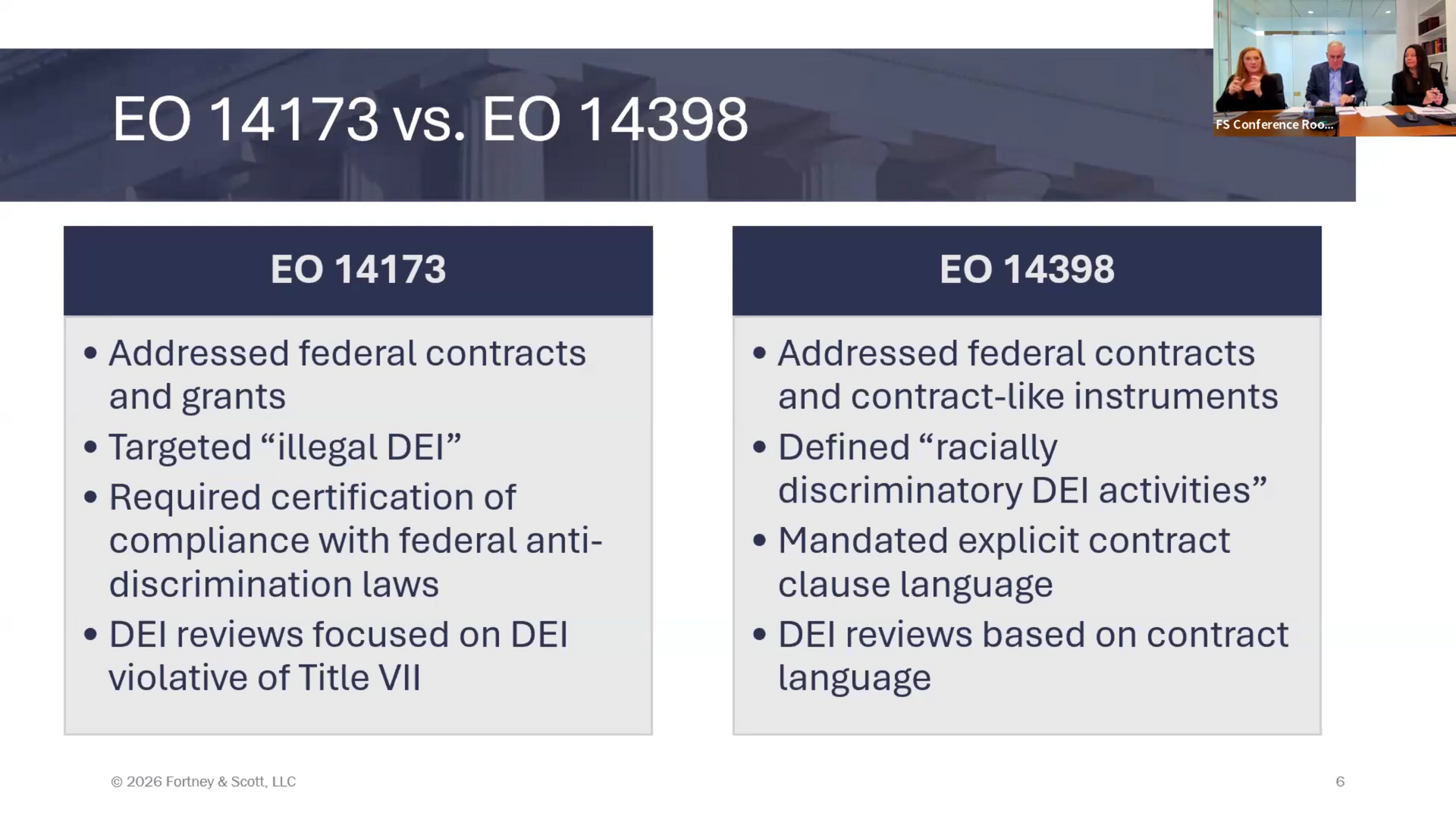
DEI continues to be a high priority issue for the Trump Administration. Recent actions by multiple federal agencies, signal increased scrutiny of employer DEI programs. In the past week alone, the Administration has taken several significant actions: The EEOC filed a subpoena enforcement action against Nike based on a May 2024 Commissioner’s charge filed by EEOC Chair Andrea Lucas. The subpoena seeks company-wide information dating back to 2018, reflecting a more expansive approach to DEI-related investigation and increased willingness to pursue enforcement in federal court. The Chair of the Federal Trade Commission issued letters to 42 leading law firms warning that participation in the Mansfield Certification program may raise antitrust concerns. EEOC Chair Lucas was copied on the correspondence, highlighting coordinated federal agency attention to diversity-based initiatives. President Trump made additional demands on Harvard concerning its DEI-practices, substantially increasing the monetary demands from $200 million to $1 billion, while signaling the possibility of additional legal action, including potential criminal exposure. Federal funding was suspended for one of the largest infrastructure projects in the U.S., the $16 Billion Hudson Tunnel project, based on minority set aside contracting requirements, prompting litigation. This action, which impacts train services between New York City and New Jersey, underscores the intersection of DEI initiatives and federal funding risks. What should employers do now? In the current enforcement environment, employers should: Continue to assess DEI programs for legal risk. With a full EEOC quorum now in place, increased scrutiny of corporate DEI programs is likely. Although most employers have reviewed their DEI programs and made necessary changes to address legal compliance, the renewed focus on DEI requires ongoing assessment and update of DEI programs. Ensuring that these best practices remain in place and are followed is crucial. Prepare for the possibility of broader EEOC investigations. Recent enforcement activity reflects an increased willingness by the EEOC to pursue company-wide inquiries, often supported by expedited subpoena enforcement in matters that originate as individual discrimination charges filed by white employees and applicants. Evaluate participation in diversity rankings and certifications. Employers should evaluate whether participation in voluntary diversity assessments, ranking programs or other public reporting of diversity results unnecessarily raises the organization's profile and invites heightened scrutiny from the EEOC and other enforcement agencies. Please contact your FortneyScott attorney or email us at info@fortneyscott.com for additional information on how to be prepared and other best practices recommendations.
Show More
February 26, 2026
The regulatory landscape continues to shift – both the U.S. Department of Labor (DOL) and the National Labor Relations Board (NLRB) have announced regulatory changes relating to independent contractors and joint employment. Overview DOL has proposed largely returning to the independent contractor rule issued in the first Trump Administration that includes a streamlined five factor economic‑reality test. The NLRB has proposed reinstating the 2020 joint employer regulation. Both of these proposed regulatory changes are positive developments for employers and, if finalized, will provide greater clarity and certainty for employer compliance. More Detailed Information DOL Rulemaking : The DOL issued a significant proposed rule to determine employee versus independent contractor status under the Fair Labor Standards Act (FLSA). DOL’s proposed rule will reinstate, with modifications, the streamlined economic‑reality test adopted during the first Trump Administration in the January 7, 2021 final rule. Under the 2021 rule, the DOL applied a streamlined economic‑reality test that focused on whether a worker is economically dependent on the employer or is operating an independent business. The 2021 rule identifies five factors to apply with the first two factors carrying more weight : (1) the nature and degree of control over the work; (2) the worker’s opportunity for profit or loss; (3) skill required for the work; (4) permanence of the working relationship; and (5) whether the work is part of an integrated unit of production. The DOL’s modifications to the 2021 standard seek to clarify whether a worker depends on the company to provide work, as opposed to depending on their own business to generate work opportunities. The analysis focuses on the source of work, not the percentage of income the worker earns from a particular company. The DOL also proposes to extend this updated analysis to the Family and Medical Leave Act (FMLA) and the Migrant and Seasonal Agricultural Worker Protection Act (MSPA), both of which rely on the FLSA’s definition of “employment.” Key Takeaways for DOL IC Rule: The DOL’s 2024 rule, which established a six-factor test that created significant uncertainties when applied, will be rescinded. The DOL proposes returning to the 2021 rule’s five-factor test, with certain updates. The same analysis would apply under the FMLA and MSPA, aligning worker classification standards across these laws to reduce compliance and enforcement risks. The proposed changes support employer interests and will enable employers to assess independent contractor relationships and mitigate compliance and enforcement risks. If finalized, this rule should have wide-reaching implications for employers, contractors, gig economy platforms, and industries that rely on flexible labor models. NLRB Withdraws and Replaces its Joint Employer Regulation: The National Labor Relations Board will issue a final rule withdrawing its 2023 Joint Employer Rule in the Federal Register on Friday, February 27, 2026. This is following a March 8, 2024 decision by the U.S. District Court for the Eastern District of Texas. Chamber of Commerce v. NLRB , 723 F.Supp. 3d 498, 519 (E.D. Tex. 2024) vacated the 2023 Rule before it took effect. As a result, the Board is reinstating the prior 2020 Joint Employer Status Under the National Labor Relations Act, codified at 29 C.F.R. § 103.40, as the governing standard for determining joint‑employer status under the National Labor Relations Act. We will continue to monitor these rulemakings closely. Please reach out to FortneyScott, if you would like to submit comments to the agencies or conduct a proactive assessment of the existing independent contractor or joint employerrelationships.
February 25, 2026
A Perspective on Trends from the DOL and on a State Government Level
February 16, 2026
Having been fully funded for FY2026 and with new leadership in place, employers can expect much more from the Department of Labor in the second year of Trump 2.0. Join FortneyScott attorneys on Tuesday, March 3, 2026 at noon EDT to learn DOL’s priorities for 2026 and how to ensure compliance. Key Topics to be Covered Include: Overview of DOL Trump 2.0 officials Budget for FY2026 Next Steps from Wage & Hour Status of regulations PAID Program Return of Opinion Letters Child Labor enforcement FY2025 recovery Project Firewall Joint project with DOJ, EEOC and USCIS over H-1Bs Future of OFCCP – What to expect from the agency now that it has been funded Key Takeaways to ensure compliance This webinar is the second in a three-part series designed for compliance professions, in-house counsel, HR and inclusion leaders, and other business leaders responsible for labor and employment law compliance. To register for FortneyScott’s Workplace Legal Compliance training series, please click here .
February 12, 2026
Fortney Scott Attorney David Fortney Co-Chairs and Speaks at the Practicing Law Institute's Annual Wage & Hour Litigation and Compliance for 2026
February 5, 2026
DEI continues to be a high priority issue for the Trump Administration. Recent actions by multiple federal agencies, signal increased scrutiny of employer DEI programs. In the past week alone, the Administration has taken several significant actions: The EEOC filed a subpoena enforcement action against Nike based on a May 2024 Commissioner’s charge filed by EEOC Chair Andrea Lucas. The subpoena seeks company-wide information dating back to 2018, reflecting a more expansive approach to DEI-related investigation and increased willingness to pursue enforcement in federal court. The Chair of the Federal Trade Commission issued letters to 42 leading law firms warning that participation in the Mansfield Certification program may raise antitrust concerns. EEOC Chair Lucas was copied on the correspondence, highlighting coordinated federal agency attention to diversity-based initiatives. President Trump made additional demands on Harvard concerning its DEI-practices, substantially increasing the monetary demands from $200 million to $1 billion, while signaling the possibility of additional legal action, including potential criminal exposure. Federal funding was suspended for one of the largest infrastructure projects in the U.S., the $16 Billion Hudson Tunnel project, based on minority set aside contracting requirements, prompting litigation. This action, which impacts train services between New York City and New Jersey, underscores the intersection of DEI initiatives and federal funding risks. What should employers do now? In the current enforcement environment, employers should: Continue to assess DEI programs for legal risk. With a full EEOC quorum now in place, increased scrutiny of corporate DEI programs is likely. Although most employers have reviewed their DEI programs and made necessary changes to address legal compliance, the renewed focus on DEI requires ongoing assessment and update of DEI programs. Ensuring that these best practices remain in place and are followed is crucial. Prepare for the possibility of broader EEOC investigations. Recent enforcement activity reflects an increased willingness by the EEOC to pursue company-wide inquiries, often supported by expedited subpoena enforcement in matters that originate as individual discrimination charges filed by white employees and applicants. Evaluate participation in diversity rankings and certifications. Employers should evaluate whether participation in voluntary diversity assessments, ranking programs or other public reporting of diversity results unnecessarily raises the organization's profile and invites heightened scrutiny from the EEOC and other enforcement agencies. Please contact your FortneyScott attorney or email us at info@fortneyscott.com for additional information on how to be prepared and other best practices recommendations.
February 4, 2026
As we move further into 2026, employers should review notable changes to DC employment laws that may impact workplace policies and compliance obligations. Minimum and Living Wage Rates : From January 1, 2026, through June 30, 2026, any DC contract or government assistance recipient receiving $100,000 or more, as well as their subcontractors receiving at least $15,000 for contracts or $50,000 for government assistance, must pay at least the living wage rate of $17.95 per hour. Starting July 1, 2026, both the minimum wage rate and the living wage rate will increase to $18.40 per hour. For tipped employees, the base minimum wage increases to $10.30 per hour on July 1, 2026. Non-Compete Restrictions : Starting January 1, 2026, employers are banned from entering non-compete agreements with employees earning less than $162,164, and with medical specialists earning less than $270,274 Pay Stub Transparency : Starting January 1, 2026, employers must itemize all sources of compensation on employees’ pay stubs, including wages, bonuses, commissions, tips, service charges, etc.
February 3, 2026
In the second year of Trump 2.0, employers must stay alert to EEOC’s shifting priorities. Join FortneyScott attorneys on Tuesday, February 3, 2026 at noon EDT to learn what to expect from EEOC and the key steps employers must take now to ensure compliance with the new EEOC priorities. Key Topics to be Covered Include:  New Commission quorum , and how it will impact EEOC priorities; Current EEOC priorities , including eliminating unlawful DEI, protecting religious liberties, limiting sex discrimination to biological sex and focusing on anti-American discrimination; Notable EEOC enforcement actions , updates, and emerging trends in the Administration’s civil rights enforcement; and, Actionable strategies and key takeaways to ensure compliance with Title VII, the PWFA, etc. This webinar is the first in a three-part series designed for compliance professionals, in-house counsel, HR and inclusion leaders, and other business leaders responsible for labor and employment law compliance.
January 23, 2026
In the second year of Trump 2.0, employers must stay alert to EEOC’s shifting priorities. Join FortneyScott attorneys on Tuesday, February 3, 2026 at noon EDT to learn what to expect from EEOC and the key steps employers must take now to ensure compliance with the new EEOC priorities. Key Topics to be Covered Include: New Commission quorum , and how it will impact EEOC priorities; Current EEOC priorities , including eliminating unlawful DEI, protecting religious liberties, limiting sex discrimination to biological sex and focusing on anti-American discrimination; Notable EEOC enforcement actions, updates, and emerging trends in the Administration’s civil rights enforcement; and, Actionable strategies and key takeaway s to ensure compliance with Title VII, the PWFA, etc. This webinar is the first in a three-part series designed for compliance professionals, in-house counsel, HR and inclusion leaders, and other business leaders responsible for labor and employment law compliance. To register for FortneyScott’s Workplace Legal Compliance training series, please click here .
January 21, 2026
As employers prepare to face the second year of Trump 2.0, FortneyScott is convening a three-month, complimentary training initiative to help clients stay ahead of the curve and confidently navigate the shifting terrain. From February through April of 2026, our Workplace Legal Compliance Series will deliver timely, practical insights through: Monthly Webinars featuring FortneyScott attorneys unpacking the latest developments. DC Insider—Employer Update Podcasts offering candid analysis from Washington insiders. Real-Time Alerts on breaking regulatory changes impacting your business. This exclusive program is tailored to equip employers with the tools they need to strengthen their compliance strategies, mitigate risk, and adapt to the new enforcement priorities taking shape in 2026. Whether you're a federal contractor, a multi-state employer, or simply seeking clarity in a volatile legal environment, FortneyScott’s training series is your go-to resource for substantive updates and actionable guidance . How to Participate : Register now for the FortneyScott Workplace Legal Compliance webinars, podcast notifications and alerts: Register here for all 3 webinars (February 3, March 3 and April 9). Sign Up for notifications of new podcast episodes of DC Insider—Employer Update. Sign Up here to receive Workplace Legal Compliance alerts and updates. If you have an immediate questions or feedback, please contact any of the FortneyScott attorneys or email info@fortneyscott.com .
More Posts