Final Pregnancy Workers Fairness Act Regulations Issued: What Employers Need to Know

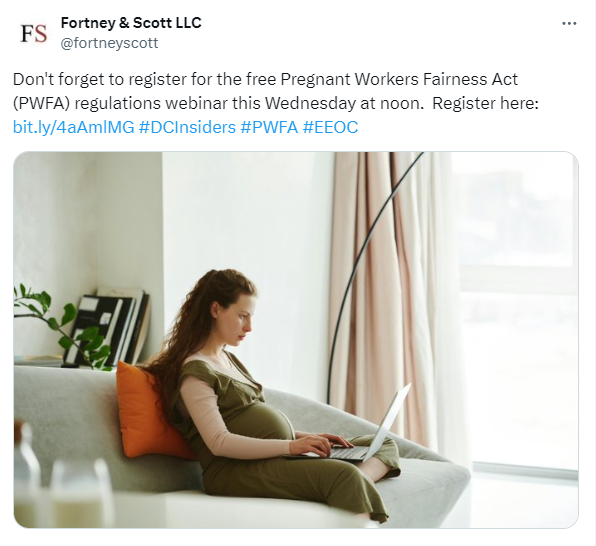
The EEOC has finally issued its final Pregnant Workers Fairness Act (PWFA). The final rule has very expansive requirements for employers to provide reasonable accommodation to a wide range of pregnancy, childbirth, and related conditions including temporary suspension of essential functions.


Join FortneyScott attorneys as they explain the new requirements and what employers need to prepare before the final rule becomes effective on June 18.

Recent Insights
February 26, 2026
The regulatory landscape continues to shift – both the U.S. Department of Labor (DOL) and the National Labor Relations Board (NLRB) have announced regulatory changes relating to independent contractors and joint employment. Overview DOL has proposed largely returning to the independent contractor rule issued in the first Trump Administration that includes a streamlined five factor economic‑reality test. The NLRB has proposed reinstating the 2020 joint employer regulation. Both of these proposed regulatory changes are positive developments for employers and, if finalized, will provide greater clarity and certainty for employer compliance. More Detailed Information DOL Rulemaking : The DOL issued a significant proposed rule to determine employee versus independent contractor status under the Fair Labor Standards Act (FLSA). DOL’s proposed rule will reinstate, with modifications, the streamlined economic‑reality test adopted during the first Trump Administration in the January 7, 2021 final rule. Under the 2021 rule, the DOL applied a streamlined economic‑reality test that focused on whether a worker is economically dependent on the employer or is operating an independent business. The 2021 rule identifies five factors to apply with the first two factors carrying more weight : (1) the nature and degree of control over the work; (2) the worker’s opportunity for profit or loss; (3) skill required for the work; (4) permanence of the working relationship; and (5) whether the work is part of an integrated unit of production. The DOL’s modifications to the 2021 standard seek to clarify whether a worker depends on the company to provide work, as opposed to depending on their own business to generate work opportunities. The analysis focuses on the source of work, not the percentage of income the worker earns from a particular company. The DOL also proposes to extend this updated analysis to the Family and Medical Leave Act (FMLA) and the Migrant and Seasonal Agricultural Worker Protection Act (MSPA), both of which rely on the FLSA’s definition of “employment.” Key Takeaways for DOL IC Rule: The DOL’s 2024 rule, which established a six-factor test that created significant uncertainties when applied, will be rescinded. The DOL proposes returning to the 2021 rule’s five-factor test, with certain updates. The same analysis would apply under the FMLA and MSPA, aligning worker classification standards across these laws to reduce compliance and enforcement risks. The proposed changes support employer interests and will enable employers to assess independent contractor relationships and mitigate compliance and enforcement risks. If finalized, this rule should have wide-reaching implications for employers, contractors, gig economy platforms, and industries that rely on flexible labor models. NLRB Withdraws and Replaces its Joint Employer Regulation: The National Labor Relations Board will issue a final rule withdrawing its 2023 Joint Employer Rule in the Federal Register on Friday, February 27, 2026. This is following a March 8, 2024 decision by the U.S. District Court for the Eastern District of Texas. Chamber of Commerce v. NLRB , 723 F.Supp. 3d 498, 519 (E.D. Tex. 2024) vacated the 2023 Rule before it took effect. As a result, the Board is reinstating the prior 2020 Joint Employer Status Under the National Labor Relations Act, codified at 29 C.F.R. § 103.40, as the governing standard for determining joint‑employer status under the National Labor Relations Act. We will continue to monitor these rulemakings closely. Please reach out to FortneyScott, if you would like to submit comments to the agencies or conduct a proactive assessment of the existing independent contractor or joint employerrelationships.
February 25, 2026
A Perspective on Trends from the DOL and on a State Government Level
Show More

The EEOC has finally issued its final Pregnant Workers Fairness Act (PWFA). The final rule has very expansive requirements for employers to provide reasonable accommodation to a wide range of pregnancy, childbirth, and related conditions including temporary suspension of essential functions.


Join FortneyScott attorneys as they explain the new requirements and what employers need to prepare before the final rule becomes effective on June 18.

Recent Insights
February 26, 2026
The regulatory landscape continues to shift – both the U.S. Department of Labor (DOL) and the National Labor Relations Board (NLRB) have announced regulatory changes relating to independent contractors and joint employment. Overview DOL has proposed largely returning to the independent contractor rule issued in the first Trump Administration that includes a streamlined five factor economic‑reality test. The NLRB has proposed reinstating the 2020 joint employer regulation. Both of these proposed regulatory changes are positive developments for employers and, if finalized, will provide greater clarity and certainty for employer compliance. More Detailed Information DOL Rulemaking : The DOL issued a significant proposed rule to determine employee versus independent contractor status under the Fair Labor Standards Act (FLSA). DOL’s proposed rule will reinstate, with modifications, the streamlined economic‑reality test adopted during the first Trump Administration in the January 7, 2021 final rule. Under the 2021 rule, the DOL applied a streamlined economic‑reality test that focused on whether a worker is economically dependent on the employer or is operating an independent business. The 2021 rule identifies five factors to apply with the first two factors carrying more weight : (1) the nature and degree of control over the work; (2) the worker’s opportunity for profit or loss; (3) skill required for the work; (4) permanence of the working relationship; and (5) whether the work is part of an integrated unit of production. The DOL’s modifications to the 2021 standard seek to clarify whether a worker depends on the company to provide work, as opposed to depending on their own business to generate work opportunities. The analysis focuses on the source of work, not the percentage of income the worker earns from a particular company. The DOL also proposes to extend this updated analysis to the Family and Medical Leave Act (FMLA) and the Migrant and Seasonal Agricultural Worker Protection Act (MSPA), both of which rely on the FLSA’s definition of “employment.” Key Takeaways for DOL IC Rule: The DOL’s 2024 rule, which established a six-factor test that created significant uncertainties when applied, will be rescinded. The DOL proposes returning to the 2021 rule’s five-factor test, with certain updates. The same analysis would apply under the FMLA and MSPA, aligning worker classification standards across these laws to reduce compliance and enforcement risks. The proposed changes support employer interests and will enable employers to assess independent contractor relationships and mitigate compliance and enforcement risks. If finalized, this rule should have wide-reaching implications for employers, contractors, gig economy platforms, and industries that rely on flexible labor models. NLRB Withdraws and Replaces its Joint Employer Regulation: The National Labor Relations Board will issue a final rule withdrawing its 2023 Joint Employer Rule in the Federal Register on Friday, February 27, 2026. This is following a March 8, 2024 decision by the U.S. District Court for the Eastern District of Texas. Chamber of Commerce v. NLRB , 723 F.Supp. 3d 498, 519 (E.D. Tex. 2024) vacated the 2023 Rule before it took effect. As a result, the Board is reinstating the prior 2020 Joint Employer Status Under the National Labor Relations Act, codified at 29 C.F.R. § 103.40, as the governing standard for determining joint‑employer status under the National Labor Relations Act. We will continue to monitor these rulemakings closely. Please reach out to FortneyScott, if you would like to submit comments to the agencies or conduct a proactive assessment of the existing independent contractor or joint employerrelationships.
February 25, 2026
A Perspective on Trends from the DOL and on a State Government Level
February 16, 2026
Having been fully funded for FY2026 and with new leadership in place, employers can expect much more from the Department of Labor in the second year of Trump 2.0. Join FortneyScott attorneys on Tuesday, March 3, 2026 at noon EDT to learn DOL’s priorities for 2026 and how to ensure compliance. Key Topics to be Covered Include: Overview of DOL Trump 2.0 officials Budget for FY2026 Next Steps from Wage & Hour Status of regulations PAID Program Return of Opinion Letters Child Labor enforcement FY2025 recovery Project Firewall Joint project with DOJ, EEOC and USCIS over H-1Bs Future of OFCCP – What to expect from the agency now that it has been funded Key Takeaways to ensure compliance This webinar is the second in a three-part series designed for compliance professions, in-house counsel, HR and inclusion leaders, and other business leaders responsible for labor and employment law compliance. To register for FortneyScott’s Workplace Legal Compliance training series, please click here .
Show More

DC INSIDER - EMPLOYER UPDATE™

Check Out The Latest Episode

Subscribe To Podcast →

Latest FortneyScott Updates