DOL Requests Comments for Draft Strategic Plan

November 6, 2017


On Tuesday, November 7, 2017, the U.S. Department of Labor (DOL) will publish a request for comments on its draft FY2018-2022 Strategic Plan in the Federal Register.  The draft strategy plan itself can be found here or on the DOL website. The notice will open a period of 30 days in which stakeholders can comment on the draft Strategic Plan. The notice states that the draft Strategic Plan represents “the Secretary’s vision, the Department’s mission, and a description of how component agencies will achieve supporting goals and strategic objectives in the next four years.”


The draft strategic plan has a total of four goals.  The first strategic DOL goal-Support the Ability of All Americans to Find Good Jobs-focuses on how to use DOL resources to close the current skills gap such as apprenticeships and training as well as how to increase the job opportunities for veterans and their spouses; for individuals with disabilities and working women. Interestingly, the Strategic Plan notes that the Bureau of Labor Statistics (BLS) should provide timely, accurate and relevant information on the labor market, working conditions and price changes.  BLS was attacked by President Trump during the 2016 election for providing inaccurate data.


The second strategic goal-Safe Jobs and Fair Workplaces-outlines the plans for each of the enforcement agencies under the DOL. The common denominator for OSHA, MSHA, Wage & Hour, OFCCP, ILAB and OLMS is increased focus on compliance assistance to employers.  The Wage and Hour Division specifically indicates it is planning to modernize its compliance assistance, while the OFCCP states that it will expand its compliance assistance and stakeholder engagement.


The third strategic goal-Promote Strong Workers’ Compensation and Benefits Programs-covers the DOL’s agencies that handle workers’ compensation, unemployment compensation, and retirement security.


The DOL’s Management Goal has the usual discussion of working more effectively, more efficiently and with more accountability.  More to the point, however, is the DOL’s goal to upgrade its technology capability which would increase its ability to work smarter with fewer employees.


Surprisingly, the Strategic Plan does not mention how it will comply with the OMB initiative to restructure the federal government to reduce the size of the civilian workforce and eliminate unnecessary programs although the strategic plan although the plan indicates that reform plan initiatives will be inserted in the December revised draft.


FortneyScott is planning on preparing comments. If you are interested in participating, please contact David S. Fortney .
 

February 24, 2026
State of Civil Rights Under Trump 2.0
February 16, 2026
Having been fully funded for FY2026 and with new leadership in place, employers can expect much more from the Department of Labor in the second year of Trump 2.0. Join FortneyScott attorneys on Tuesday, March 3, 2026 at noon EDT to learn DOL’s priorities for 2026 and how to ensure compliance. Key Topics to be Covered Include: Overview of DOL Trump 2.0 officials Budget for FY2026 Next Steps from Wage & Hour Status of regulations PAID Program Return of Opinion Letters Child Labor enforcement FY2025 recovery Project Firewall Joint project with DOJ, EEOC and USCIS over H-1Bs Future of OFCCP – What to expect from the agency now that it has been funded Key Takeaways to ensure compliance This webinar is the second in a three-part series designed for compliance professions, in-house counsel, HR and inclusion leaders, and other business leaders responsible for labor and employment law compliance. To register for FortneyScott’s Workplace Legal Compliance training series, please click here .
February 12, 2026
Fortney Scott Attorney David Fortney Co-Chairs and Speaks at the Practicing Law Institute's Annual Wage & Hour Litigation and Compliance for 2026
February 5, 2026
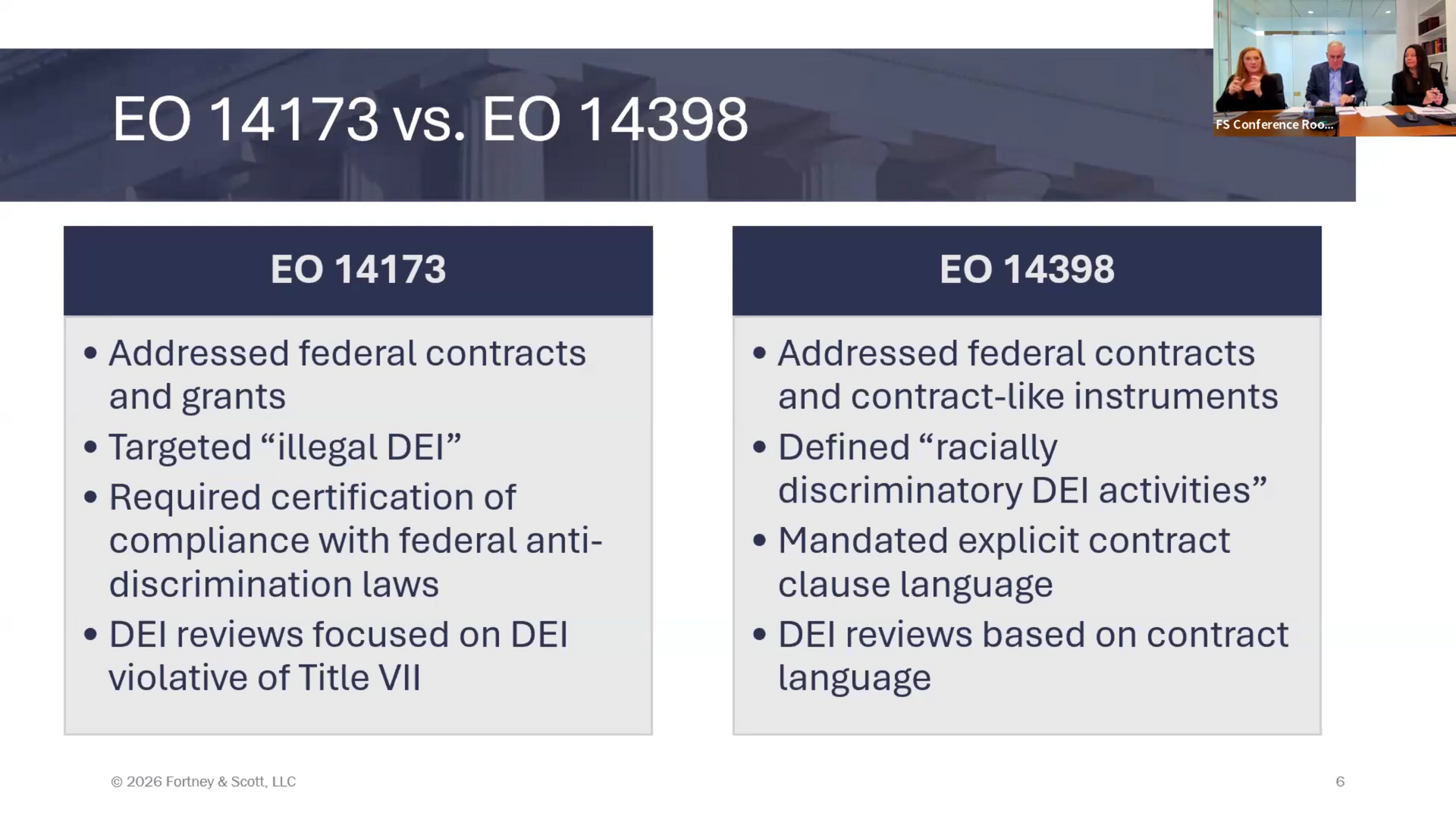
DEI continues to be a high priority issue for the Trump Administration. Recent actions by multiple federal agencies, signal increased scrutiny of employer DEI programs. In the past week alone, the Administration has taken several significant actions: The EEOC filed a subpoena enforcement action against Nike based on a May 2024 Commissioner’s charge filed by EEOC Chair Andrea Lucas. The subpoena seeks company-wide information dating back to 2018, reflecting a more expansive approach to DEI-related investigation and increased willingness to pursue enforcement in federal court. The Chair of the Federal Trade Commission issued letters to 42 leading law firms warning that participation in the Mansfield Certification program may raise antitrust concerns. EEOC Chair Lucas was copied on the correspondence, highlighting coordinated federal agency attention to diversity-based initiatives. President Trump made additional demands on Harvard concerning its DEI-practices, substantially increasing the monetary demands from $200 million to $1 billion, while signaling the possibility of additional legal action, including potential criminal exposure. Federal funding was suspended for one of the largest infrastructure projects in the U.S., the $16 Billion Hudson Tunnel project, based on minority set aside contracting requirements, prompting litigation. This action, which impacts train services between New York City and New Jersey, underscores the intersection of DEI initiatives and federal funding risks. What should employers do now? In the current enforcement environment, employers should: Continue to assess DEI programs for legal risk. With a full EEOC quorum now in place, increased scrutiny of corporate DEI programs is likely. Although most employers have reviewed their DEI programs and made necessary changes to address legal compliance, the renewed focus on DEI requires ongoing assessment and update of DEI programs. Ensuring that these best practices remain in place and are followed is crucial. Prepare for the possibility of broader EEOC investigations. Recent enforcement activity reflects an increased willingness by the EEOC to pursue company-wide inquiries, often supported by expedited subpoena enforcement in matters that originate as individual discrimination charges filed by white employees and applicants. Evaluate participation in diversity rankings and certifications. Employers should evaluate whether participation in voluntary diversity assessments, ranking programs or other public reporting of diversity results unnecessarily raises the organization's profile and invites heightened scrutiny from the EEOC and other enforcement agencies. Please contact your FortneyScott attorney or email us at info@fortneyscott.com for additional information on how to be prepared and other best practices recommendations.
February 4, 2026
As we move further into 2026, employers should review notable changes to DC employment laws that may impact workplace policies and compliance obligations. Minimum and Living Wage Rates : From January 1, 2026, through June 30, 2026, any DC contract or government assistance recipient receiving $100,000 or more, as well as their subcontractors receiving at least $15,000 for contracts or $50,000 for government assistance, must pay at least the living wage rate of $17.95 per hour. Starting July 1, 2026, both the minimum wage rate and the living wage rate will increase to $18.40 per hour. For tipped employees, the base minimum wage increases to $10.30 per hour on July 1, 2026. Non-Compete Restrictions : Starting January 1, 2026, employers are banned from entering non-compete agreements with employees earning less than $162,164, and with medical specialists earning less than $270,274 Pay Stub Transparency : Starting January 1, 2026, employers must itemize all sources of compensation on employees’ pay stubs, including wages, bonuses, commissions, tips, service charges, etc.
February 3, 2026
In the second year of Trump 2.0, employers must stay alert to EEOC’s shifting priorities. Join FortneyScott attorneys on Tuesday, February 3, 2026 at noon EDT to learn what to expect from EEOC and the key steps employers must take now to ensure compliance with the new EEOC priorities. Key Topics to be Covered Include:  New Commission quorum , and how it will impact EEOC priorities; Current EEOC priorities , including eliminating unlawful DEI, protecting religious liberties, limiting sex discrimination to biological sex and focusing on anti-American discrimination; Notable EEOC enforcement actions , updates, and emerging trends in the Administration’s civil rights enforcement; and, Actionable strategies and key takeaways to ensure compliance with Title VII, the PWFA, etc. This webinar is the first in a three-part series designed for compliance professionals, in-house counsel, HR and inclusion leaders, and other business leaders responsible for labor and employment law compliance.
Show More
February 24, 2026
State of Civil Rights Under Trump 2.0
February 16, 2026
Having been fully funded for FY2026 and with new leadership in place, employers can expect much more from the Department of Labor in the second year of Trump 2.0. Join FortneyScott attorneys on Tuesday, March 3, 2026 at noon EDT to learn DOL’s priorities for 2026 and how to ensure compliance. Key Topics to be Covered Include: Overview of DOL Trump 2.0 officials Budget for FY2026 Next Steps from Wage & Hour Status of regulations PAID Program Return of Opinion Letters Child Labor enforcement FY2025 recovery Project Firewall Joint project with DOJ, EEOC and USCIS over H-1Bs Future of OFCCP – What to expect from the agency now that it has been funded Key Takeaways to ensure compliance This webinar is the second in a three-part series designed for compliance professions, in-house counsel, HR and inclusion leaders, and other business leaders responsible for labor and employment law compliance. To register for FortneyScott’s Workplace Legal Compliance training series, please click here .
February 12, 2026
Fortney Scott Attorney David Fortney Co-Chairs and Speaks at the Practicing Law Institute's Annual Wage & Hour Litigation and Compliance for 2026
February 5, 2026
DEI continues to be a high priority issue for the Trump Administration. Recent actions by multiple federal agencies, signal increased scrutiny of employer DEI programs. In the past week alone, the Administration has taken several significant actions: The EEOC filed a subpoena enforcement action against Nike based on a May 2024 Commissioner’s charge filed by EEOC Chair Andrea Lucas. The subpoena seeks company-wide information dating back to 2018, reflecting a more expansive approach to DEI-related investigation and increased willingness to pursue enforcement in federal court. The Chair of the Federal Trade Commission issued letters to 42 leading law firms warning that participation in the Mansfield Certification program may raise antitrust concerns. EEOC Chair Lucas was copied on the correspondence, highlighting coordinated federal agency attention to diversity-based initiatives. President Trump made additional demands on Harvard concerning its DEI-practices, substantially increasing the monetary demands from $200 million to $1 billion, while signaling the possibility of additional legal action, including potential criminal exposure. Federal funding was suspended for one of the largest infrastructure projects in the U.S., the $16 Billion Hudson Tunnel project, based on minority set aside contracting requirements, prompting litigation. This action, which impacts train services between New York City and New Jersey, underscores the intersection of DEI initiatives and federal funding risks. What should employers do now? In the current enforcement environment, employers should: Continue to assess DEI programs for legal risk. With a full EEOC quorum now in place, increased scrutiny of corporate DEI programs is likely. Although most employers have reviewed their DEI programs and made necessary changes to address legal compliance, the renewed focus on DEI requires ongoing assessment and update of DEI programs. Ensuring that these best practices remain in place and are followed is crucial. Prepare for the possibility of broader EEOC investigations. Recent enforcement activity reflects an increased willingness by the EEOC to pursue company-wide inquiries, often supported by expedited subpoena enforcement in matters that originate as individual discrimination charges filed by white employees and applicants. Evaluate participation in diversity rankings and certifications. Employers should evaluate whether participation in voluntary diversity assessments, ranking programs or other public reporting of diversity results unnecessarily raises the organization's profile and invites heightened scrutiny from the EEOC and other enforcement agencies. Please contact your FortneyScott attorney or email us at info@fortneyscott.com for additional information on how to be prepared and other best practices recommendations.
February 4, 2026
As we move further into 2026, employers should review notable changes to DC employment laws that may impact workplace policies and compliance obligations. Minimum and Living Wage Rates : From January 1, 2026, through June 30, 2026, any DC contract or government assistance recipient receiving $100,000 or more, as well as their subcontractors receiving at least $15,000 for contracts or $50,000 for government assistance, must pay at least the living wage rate of $17.95 per hour. Starting July 1, 2026, both the minimum wage rate and the living wage rate will increase to $18.40 per hour. For tipped employees, the base minimum wage increases to $10.30 per hour on July 1, 2026. Non-Compete Restrictions : Starting January 1, 2026, employers are banned from entering non-compete agreements with employees earning less than $162,164, and with medical specialists earning less than $270,274 Pay Stub Transparency : Starting January 1, 2026, employers must itemize all sources of compensation on employees’ pay stubs, including wages, bonuses, commissions, tips, service charges, etc.
February 3, 2026
In the second year of Trump 2.0, employers must stay alert to EEOC’s shifting priorities. Join FortneyScott attorneys on Tuesday, February 3, 2026 at noon EDT to learn what to expect from EEOC and the key steps employers must take now to ensure compliance with the new EEOC priorities. Key Topics to be Covered Include:  New Commission quorum , and how it will impact EEOC priorities; Current EEOC priorities , including eliminating unlawful DEI, protecting religious liberties, limiting sex discrimination to biological sex and focusing on anti-American discrimination; Notable EEOC enforcement actions , updates, and emerging trends in the Administration’s civil rights enforcement; and, Actionable strategies and key takeaways to ensure compliance with Title VII, the PWFA, etc. This webinar is the first in a three-part series designed for compliance professionals, in-house counsel, HR and inclusion leaders, and other business leaders responsible for labor and employment law compliance.
January 23, 2026
In the second year of Trump 2.0, employers must stay alert to EEOC’s shifting priorities. Join FortneyScott attorneys on Tuesday, February 3, 2026 at noon EDT to learn what to expect from EEOC and the key steps employers must take now to ensure compliance with the new EEOC priorities. Key Topics to be Covered Include: New Commission quorum , and how it will impact EEOC priorities; Current EEOC priorities , including eliminating unlawful DEI, protecting religious liberties, limiting sex discrimination to biological sex and focusing on anti-American discrimination; Notable EEOC enforcement actions, updates, and emerging trends in the Administration’s civil rights enforcement; and, Actionable strategies and key takeaway s to ensure compliance with Title VII, the PWFA, etc. This webinar is the first in a three-part series designed for compliance professionals, in-house counsel, HR and inclusion leaders, and other business leaders responsible for labor and employment law compliance. To register for FortneyScott’s Workplace Legal Compliance training series, please click here .
January 21, 2026
As employers prepare to face the second year of Trump 2.0, FortneyScott is convening a three-month, complimentary training initiative to help clients stay ahead of the curve and confidently navigate the shifting terrain. From February through April of 2026, our Workplace Legal Compliance Series will deliver timely, practical insights through: Monthly Webinars featuring FortneyScott attorneys unpacking the latest developments. DC Insider—Employer Update Podcasts offering candid analysis from Washington insiders. Real-Time Alerts on breaking regulatory changes impacting your business. This exclusive program is tailored to equip employers with the tools they need to strengthen their compliance strategies, mitigate risk, and adapt to the new enforcement priorities taking shape in 2026. Whether you're a federal contractor, a multi-state employer, or simply seeking clarity in a volatile legal environment, FortneyScott’s training series is your go-to resource for substantive updates and actionable guidance . How to Participate : Register now for the FortneyScott Workplace Legal Compliance webinars, podcast notifications and alerts: Register here for all 3 webinars (February 3, March 3 and April 9). Sign Up for notifications of new podcast episodes of DC Insider—Employer Update. Sign Up here to receive Workplace Legal Compliance alerts and updates. If you have an immediate questions or feedback, please contact any of the FortneyScott attorneys or email info@fortneyscott.com .
December 18, 2025
Join FortneyScott attorneys for a complimentary webinar on how employers should prepare for 2026 based on the significant changes in 2025. The Trump Administration begins 2026 with a quorum at the EEOC, new leadership at all the DOL agencies, and the likelihood that the NLRB quorum will be restored soon, so employers should expect aggressive action by all the workforce agencies. This session will provide critical insights into: What to expect from EEOC with its new quorum; An activated DOL, including the new Wage & Hour Division priorities, such as revisions to the Biden-era rules on white collar exemptions and joint employment; new Opinion Letters and compliance tools, how AI is being addressed, and expected developments; Whether OFCCP will survive in 2026, and changes affecting Federal contractors and grant recipients; and Practical steps employers should consider before 2026 begins. This is the final presentation in FortneyScott’s four-part Workplace Legal Compliance Webinar Series 2025, designed for in-house counsel, compliance professionals, HR leaders, and business executives.
December 18, 2025
Join FortneyScott attorneys for a timely webinar addressing the Trump Administration’s escalating enforcement efforts targeting “illegal DEI” practices among federal contractors, grant recipients, and higher education institutions. In recent months, the Administration has initiated certification demands, expanded DOJ investigations under the False Claims Act, and increased EEOC scrutiny under Title VII. This session will provide critical insights into: The latest developments in federal investigations and enforcement; DEI programs under legal challenge; and Practical steps employers—especially federal contractors and grant recipients—should take now to mitigate legal risk and ensure compliance with EEO laws. This is the third installment in FortneyScott’s four-part Workplace Legal Compliance Webinar Series, designed for in-house counsel, compliance professionals, HR leaders, and business executives.
More Posts